Some links on this page are affiliate links. If you purchase through them, FirstPawGuide may earn a commission at no additional cost to you. Recommendations are based on editorial evaluation and are not influenced by affiliate partnerships.
Best Automatic Cat Feeder for First-Time Owners: Which Type Fits Your Feeding Routine?
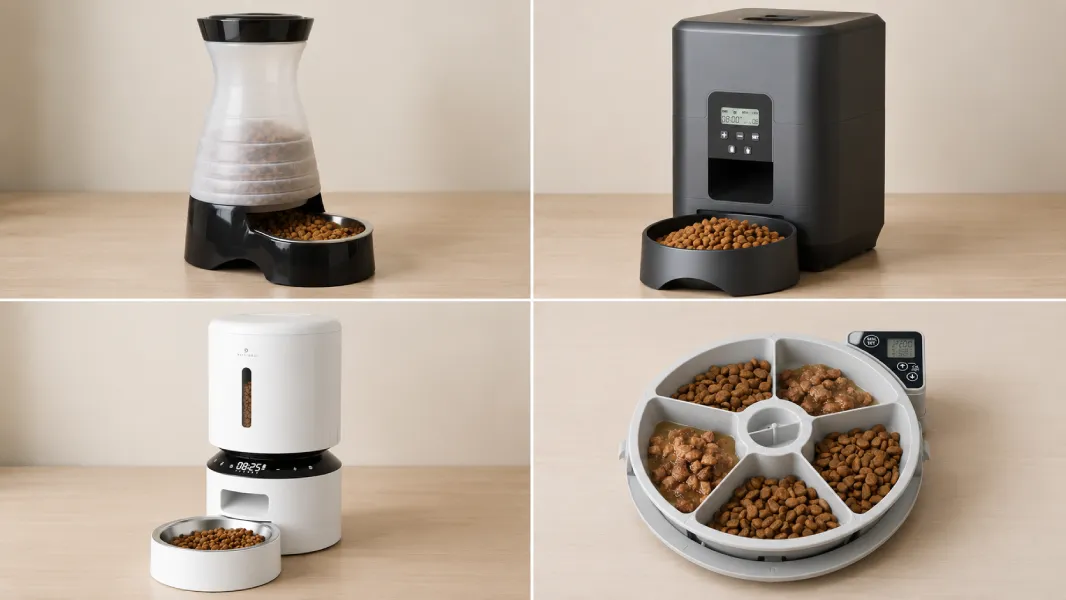
There’s no single best automatic cat feeder for every situation — the right type depends on your feeding routine, your schedule, and how much control you need over portion size and timing. If you’ve already decided on dry food because of an unpredictable schedule, this guide helps you choose the feeder type that supports that routine. Four main types are covered: gravity feeders, programmable portion-control feeders, smart feeders, and wet food compatible feeders. Each one fits a different set of feeding conditions.
For a broader overview of everything to set up before your cat arrives, the complete first-time cat owner guide covers feeder selection alongside every other essential decision.
What This Guide Covers
- Four feeder types — gravity, programmable, smart, and wet food compatible — each match a different feeding routine, not a single “best” feeder for every household.
- Capacity, portion accuracy, and food compatibility determine whether a feeder actually supports your routine or creates new problems you didn’t have before.
- The quick decision guide at the end matches your schedule, cat count, and food type to the right starting feeder, with room to upgrade later.
What Makes a Good Automatic Cat Feeder for a First-Time Owner?
Before getting into scenario-specific recommendations, here are seven criteria worth considering. These aren’t product specifications — they’re decision attributes that will help you evaluate which type genuinely supports your feeding routine.
- Food capacity relative to your cat’s daily portion — the feeder needs enough capacity to run unsupervised for the period you need it to; a feeder that runs out mid-day defeats its purpose entirely
- Portion size accuracy — how precisely the feeder dispenses each meal; gravity feeders don’t control portions at all, programmable feeders do
- Number of meals per day — most programmable feeders support two to six meals; match this to your cat’s feeding schedule, not just the feeder’s maximum capability
- Power source — AC adapter, batteries, or both; a feeder with battery backup protects scheduled meals against power outages during a workday
- Ease of cleaning — food residue accumulates in dispensing mechanisms over time; removable bowls and accessible components matter for consistent daily maintenance
- Food compatibility — most automatic feeders work with dry kibble only; wet or semi-moist food requires a feeder specifically designed to handle it
- Reliability of the dispensing mechanism — jamming is the most common failure point; consistent dispensing across different kibble sizes is worth verifying before buying
Focus on capacity, portion accuracy, and food compatibility first — these three determine whether the feeder actually supports your routine or creates new management problems you didn’t have before.
Best Automatic Cat Feeder for Irregular Schedules and Long Work Hours
Works well if
- Your work hours are long or inconsistent and you can’t reliably be home for every meal
- You want consistent meal timing without needing an app or remote access
- Your cat does well on a structured two-to-four meal-per-day schedule
Less suitable if
- You want confirmation that a meal was actually dispensed — this type gives you none
- You don’t have battery backup and a power outage during the day would leave you uncertain
For most first-time cat owners who work full time, this is the primary scenario: long or unpredictable hours make consistent manual feeding at the same time every day genuinely difficult to sustain.
A programmable portion-control feeder — without app connectivity — fits this situation best. It dispenses a set portion at a scheduled time, consistently, without requiring you to be present for each meal. You configure the schedule and portion size once, and the feeder runs it every day. For a cat that needs consistent meal timing but whose owner can’t reliably be home for every feeding, this is the most straightforward solution available: no app to manage, no connectivity to troubleshoot, no complexity beyond the core function you actually need. This type also works well as a starting point before evaluating whether smart feeder features would genuinely add anything to your specific routine. These feeders work with dry kibble — the format that’s most compatible with automatic dispensing for most cats.
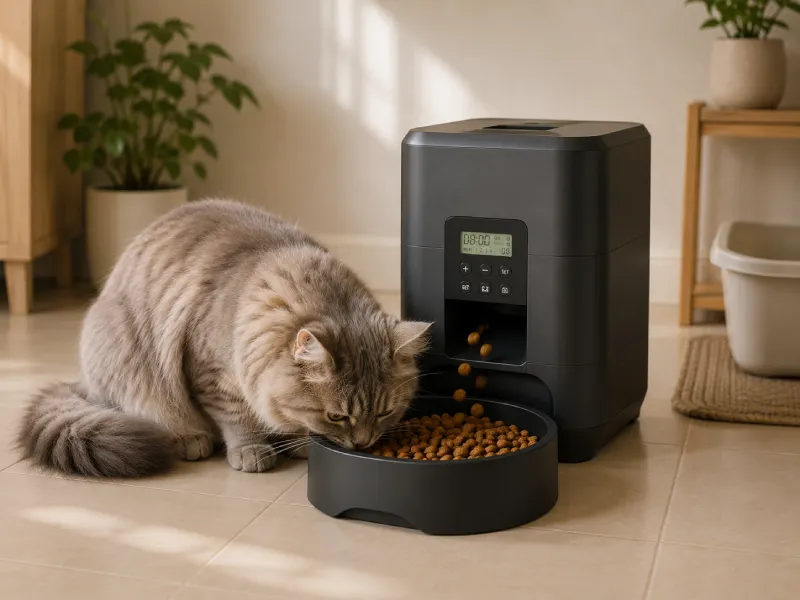
One trade-off to understand before choosing this type: a programmable feeder without app connectivity gives you no confirmation that a meal was actually dispensed. If the mechanism jams or the power fails mid-day, you won’t know until you get home. A feeder with battery backup addresses the power concern; dispensing reliability requires checking reviews for the specific model you’re considering before purchasing.
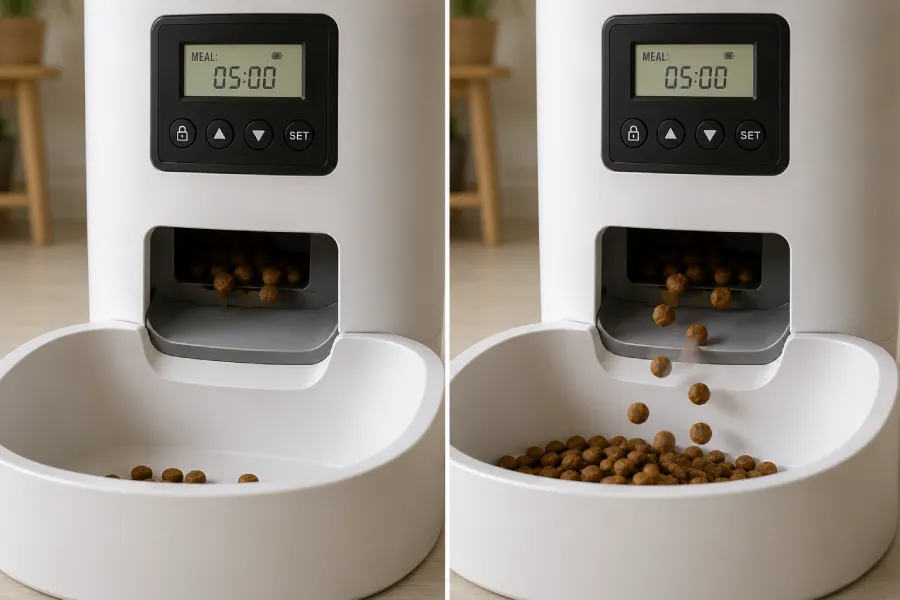
Most programmable feeders allow portion size adjustment per meal — set this based on your cat’s daily food requirement divided across the number of scheduled meals, not the feeder’s maximum capacity.
Choose this if:
- Your work hours are long or inconsistent and you can’t reliably be home for every scheduled meal
- You want consistent meal timing without needing an app or remote access to manage it
- Your cat does well on a structured two-to-four meal-per-day schedule
- You want a reliable, lower-complexity solution before considering smart feeder features
![[Product Name] — programmable portion-control cat feeder](/assets/images/products/[programmable-feeder-product-image].webp)
[Product Name]
Best for: Owners with long or unpredictable work hours who want consistent meal timing
[Reason — 1-2 sentences, decision-context framing]
Best Automatic Cat Feeder for Precise Portion Control and Multiple Cats
Works well if
- You have two or more cats that need different portion sizes or feeding schedules
- One cat consistently eats another’s food and standard bowl arrangements haven’t resolved it
- You’re willing to invest in a higher-cost setup for reliable per-cat enforcement
Less suitable if
- Budget is a primary concern — microchip feeders cost significantly more than standard programmable feeders
- You’re not willing to microchip or fit an RFID collar tag on each cat before the feeder is usable
If you have more than one cat with different portion needs — or a single cat that requires a very specific and consistent daily intake — a standard single-bowl feeder can’t reliably solve the problem on its own.
A multi-cat programmable feeder or microchip-activated feeder fits this situation best. It allows individual portion control per cat rather than managing a shared bowl where any cat can eat any amount. A microchip-activated feeder works by recognizing each registered cat’s chip and opening only for that cat — the most reliable way to prevent one cat from eating another’s meal without requiring you to supervise every feeding. For households where cats consistently compete for food or where each cat needs a meaningfully different daily intake, this removes the need for manual oversight at every mealtime.
One trade-off to factor in: microchip-activated feeders are significantly more expensive than standard programmable feeders and require each cat to be microchipped or fitted with an RFID collar tag — which adds setup complexity before the feeder is usable for the first time. Bowl capacity is also smaller than standard feeders, which may mean more frequent refilling for larger cats.
Microchip feeders enforce per-cat portions by opening only for the registered individual — the most reliable mechanical solution for multi-cat households where food competition is a consistent issue.
Choose this if:
- You have two or more cats that need different portion sizes or different feeding schedules
- One cat consistently eats another’s food and standard multi-bowl arrangements haven’t resolved it
- Your cat requires a specific daily portion that needs to be consistent across every meal
- You’re willing to invest in a higher-cost setup for reliable per-cat portion enforcement
![[Product Name] — microchip-activated multi-cat feeder](/assets/images/products/[microchip-feeder-product-image].webp)
[Product Name]
Best for: Multi-cat households where food competition or different portions are an issue
[Reason — 1-2 sentences, decision-context framing]
Best Automatic Cat Feeder If You Need to Monitor and Adjust Remotely
Works well if
- You travel regularly or work genuinely variable hours and want meal confirmation
- You need to adjust feeding schedules remotely without being physically present
- Your home has a stable Wi-Fi connection where the feeder will be placed
Less suitable if
- Your home network is unreliable — remote access and notifications stop working if Wi-Fi drops
- Remote adjustment and meal confirmation aren’t a genuine part of your routine — just an aspirational feature
If you travel regularly, work genuinely variable hours, or want confirmation that a meal was dispensed while you were away — a standard programmable feeder without connectivity can’t give you that information.
A smart feeder — app-connected, Wi-Fi enabled — fits this situation best. It lets you adjust feeding schedules remotely and sends a notification when a meal is dispensed, so you’re not left wondering whether your cat was fed during a long or unpredictable day away from home. If your routine genuinely varies day to day — sometimes home early, sometimes very late — the ability to push a schedule change from your phone without being physically at the feeder is a real workflow difference, not just a convenience feature. Meal confirmation also removes the uncertainty that a programmable feeder without connectivity leaves unresolved. Some smart feeders include a camera — useful for confirming your cat is actually eating, not as a standalone reason to choose this type.
One trade-off to know before buying: smart feeders depend on a stable Wi-Fi connection — if your home network drops, remote access and notifications stop working. They’re also the most expensive feeder type and have more components that can malfunction than simpler models. The added complexity is only worth the cost if remote adjustment and meal confirmation are genuinely part of how you manage your cat’s feeding routine — not aspirational features that sound useful but rarely get used.
Most smart feeders retain programmable portion control as a baseline — remote access adds schedule flexibility on top of that core function, it doesn’t replace it.
Choose this if:
- You travel regularly or work genuinely variable hours and want confirmation that meals were dispensed while you were away
- You need to adjust feeding schedules remotely without being physically present at the feeder
- Real-time feeding notifications are a practical need in your daily routine, not just a nice-to-have
- Your home has a stable Wi-Fi connection in the location where the feeder will be placed
![[Product Name] — Wi-Fi connected smart cat feeder](/assets/images/products/[smart-feeder-product-image].webp)
[Product Name]
Best for: Owners who travel or work variable hours and want remote meal confirmation
[Reason — 1-2 sentences, decision-context framing]
Best Automatic Cat Feeder If You Feed Wet Food
Works well if
- You already feed wet food and need to automate meal timing
- Your time away from home is short enough that a two-to-five meal tray capacity covers it
- You’re willing to prepare ice packs or use a feeder with cooling capability
Less suitable if
- You need full-day unsupervised capacity — tray feeders hold far less than dry food feeders
- You haven’t confirmed the specific model is actually designed for wet food — the label alone isn’t enough
If wet food is already your feeding choice and you need to automate meal timing — this is a scenario defined by a specific constraint: most automatic feeders aren’t designed for wet food, and using the wrong one means food that spoils before your cat gets to it.
A wet food compatible feeder — rotating tray or ice pack design — fits this situation not because it’s a superior feeder type in general, but because it’s the only type built to handle wet food safely. A rotating tray feeder stores several pre-portioned servings in separate compartments that rotate into position at scheduled times, keeping unserved portions covered until their scheduled meal. Feeders with ice packs or a cooling compartment extend the safe window for wet food at room temperature — important if the gap between meals is longer than one to two hours. If wet food is already your feeding choice and you need to automate the timing, this is the feeder type designed for that specific constraint.
One trade-off built into the design: wet food feeders have significantly less capacity than dry food feeders — rotating tray designs typically accommodate two to five pre-portioned meals, not a full day’s supply for extended absences. Wet food also has a limited safe window at room temperature before it should be discarded; feeders with ice packs extend this window but add a preparation step before each use.
Wet food feeders portion by tray compartment rather than by weight — portion consistency depends on how consistently you fill each compartment before use, not on the feeder’s mechanism.
Choose this if:
- You already feed wet food and need to automate meal timing for a predictable schedule
- Your time away from home is short enough that a two-to-five meal tray capacity covers the period
- You’re willing to prepare ice packs or use a feeder with cooling capability to keep wet food fresh between meals
- You’ve confirmed the specific feeder model is designed for wet food — not all automatic feeders support wet food formats, and the label alone isn’t enough to verify this
![[Product Name] — wet food compatible rotating tray feeder](/assets/images/products/[wet-food-feeder-product-image].webp)
[Product Name]
Best for: Owners who already feed wet food and need to automate the timing
[Reason — 1-2 sentences, decision-context framing]
Best Automatic Cat Feeder If Budget Is a Primary Consideration
Works well if
- You’re managing multiple startup costs simultaneously
- Your cat appears to self-regulate food intake — not eating past satiation when food is available
- You plan to reassess after observing your cat’s feeding behavior over the first few months
Less suitable if
- Your cat eats past satiation when food is continuously available — a gravity feeder provides no portion control whatsoever
If you’re managing multiple startup purchases at once, choosing a functional feeder without premium features is a practical and entirely reasonable decision.
A gravity feeder or basic programmable feeder works reliably and is straightforward to maintain. A gravity feeder dispenses food continuously as the bowl empties — no schedule, no portion control, just a consistent supply. This works for cats that self-regulate their intake but will result in overeating for cats that don’t stop eating when food is available. If portion control matters for your cat’s daily intake, a basic programmable feeder at a slightly higher price point is a better starting point than the cheapest gravity feeder — the portion control function changes the outcome meaningfully for cats that can’t self-regulate. Starting with a basic option also gives you the opportunity to observe your cat’s actual feeding behavior before investing in more specialized features. Estimated cost: $15–$40 for a gravity feeder; $30–$60 for a basic programmable feeder, depending on brand and where you shop. Prices vary by region and retailer.
The trade-off is straightforward: gravity feeders provide no portion control whatsoever. If your cat eats past satiation when food is available, a gravity feeder won’t help — and no amount of feeder positioning or management will change that.
Gravity feeder: no portion control. Basic programmable feeder: basic portion control. Choose based on whether your cat self-regulates or needs managed portions — that distinction matters more than the price difference.
Choose this if:
- You’re managing multiple startup costs simultaneously in your first month of cat ownership
- Your cat appears to self-regulate food intake — not eating past satiation when food is continuously available
- You want functional automatic feeding before investing in portion control or smart features
- You plan to reassess after observing your cat’s feeding behavior over the first few months
![[Product Name] — gravity or basic programmable cat feeder](/assets/images/products/[gravity-feeder-product-image].webp)
[Product Name]
Best for: First-time owners managing multiple startup costs at once
[Reason — 1-2 sentences, decision-context framing]
How to Set Up Any Automatic Cat Feeder Correctly
A feeder that isn’t set up correctly creates new management problems rather than removing existing ones. These steps apply to every type covered in this article.
- Run a test cycle before relying on the feeder for a full workday — verify that each scheduled meal dispenses at the right time and in the right quantity before you need to depend on it
- Place the feeder in a consistent location your cat already associates with feeding — avoid moving it frequently once your cat has adapted to using it
- Set portions based on your cat’s daily food requirement divided across the number of scheduled meals — not the feeder’s maximum capacity per meal
- Check and charge batteries or confirm backup power before any extended absence — a feeder that loses power mid-day without backup misses scheduled meals with no alert and no way for your cat to compensate
- Clean the bowl and dispensing mechanism on a regular schedule — food residue accumulates in mechanisms over time and can cause jamming or contamination that affects dispensing reliability
- Introduce the feeder gradually if your cat is used to hand-fed meals — run it alongside manual feeding for a few days before relying on it exclusively, so your cat associates the feeder with feeding before it becomes the only source
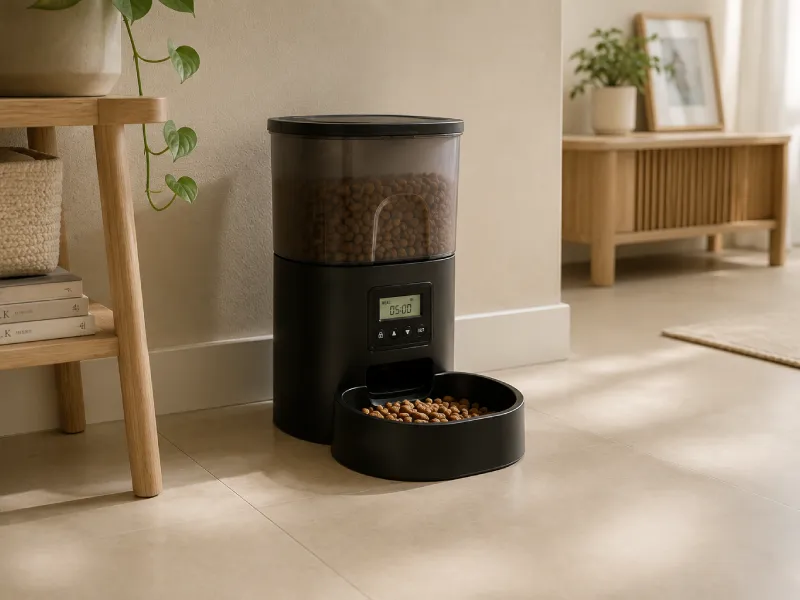
If the feeder jams or skips a meal in the first week, check kibble size compatibility before assuming the unit is defective. Most jamming issues come from kibble that’s too large or too small for the dispensing mechanism — not from a faulty feeder.
Which Automatic Cat Feeder Should You Buy? A Quick Decision Guide
Choose the scenario that sounds most like yours — not the feeder with the most features.
Quick Decision Guide
If Your Schedule Is Irregular or You Work Long Hours…
Programmable portion-control feeder. Dispenses scheduled meals consistently without requiring an app or remote access. The most reliable starting point for most first-time cat owners who work full time.
If You Need Precise Portions or Have Multiple Cats…
Multi-cat programmable feeder or microchip-activated feeder. Enables individual portion control per cat — the most reliable solution for households where cats need different amounts or where food competition is a consistent problem.
If You Need Remote Monitoring and Adjustment…
Smart feeder — app-connected. Allows schedule adjustment and meal confirmation from anywhere. Only worth the added cost and complexity if remote access is a genuine part of your daily routine, not an aspirational feature.
If You Feed Wet Food…
Wet food compatible feeder — rotating tray or ice pack design. The only type built to handle wet food safely. Verify that the specific model supports wet food before purchasing — the label alone isn’t always sufficient.
If Budget Comes First…
Gravity feeder or basic programmable feeder. Choose gravity if your cat self-regulates. Choose basic programmable if portions need to be managed. The distinction matters more than the price difference between the two.
Ready to continue your setup? Return to the new cat checklist to work through the remaining supply categories before your cat arrives.