How Much Does It Cost to Own a Cat? A Realistic Guide for First-Time Owners
The cost of owning a cat varies significantly depending on where you live, what you choose, and how you set up your home — but it follows a predictable structure that makes it plannable. Three phases shape the financial picture: before your cat arrives (startup costs), the first month (startup plus first recurring expenses), and ongoing ownership (recurring costs only). Understanding that structure is more useful than any single number, because it tells you what to expect and when to expect it.
For everything that still needs to be arranged before your cat arrives, the new cat checklist covers the full preparation list.

What This Guide Covers
- Cat ownership costs divide into one-time startup costs and ongoing monthly recurring costs — the first month combines both, which is why it always feels the most expensive.
- Realistic total monthly cost after the startup period runs $50–$150/month for most single-cat households, driven mainly by your food type choice.
- Separating startup from recurring budgets, estimating monthly costs before adoption, and setting aside a small monthly buffer are the most practical ways to make ownership costs feel planned rather than surprising.
How Cat Ownership Costs Actually Work
Before looking at specific numbers, a simple framework makes all of the costs easier to plan for. Cat ownership expenses divide into two types that work very differently from each other.
One-time or startup costs happen once — or rarely — and are concentrated in the period before and just after your cat arrives. They include supplies, the first vet visit, and the initial purchase of food and litter. These feel significant because they happen all at once, but they don’t repeat.
Recurring costs happen every month or every year — food, litter, annual vet visits, and periodic care. These are the costs that determine what cat ownership actually costs over time, and they’re the figure that matters most for long-term financial planning.
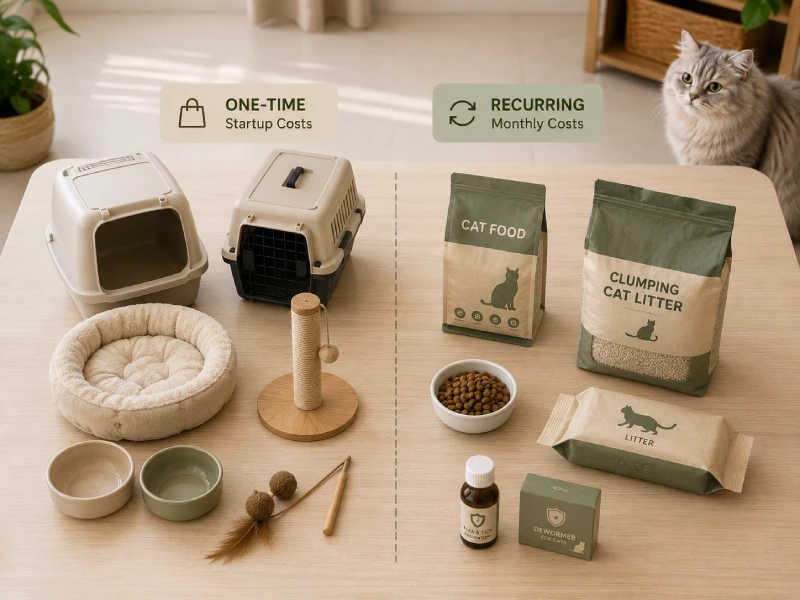
The first month is always the most expensive because it combines both: startup costs and the first month of recurring costs land at the same time. After that, expenses settle into a predictable recurring pattern that most cat owners find easier to manage than they expected. The first-month spike is normal, not a signal of what ownership will cost going forward.
Startup Costs: What You Need Before Your Cat Arrives
Startup costs are the one-time investments needed before your cat can come home. The total varies considerably based on choices you make — but the components are consistent enough to plan for.
Adoption or purchase fee: $0–$200+
The widest-ranging variable in the startup budget. Rescue adoption fees are typically free or nominal; purchasing from a breeder costs significantly more. This is the component least worth trying to estimate precisely because it depends entirely on how you’re acquiring your cat.
Essential supplies: $100–$300
Litter box, carrier, food and water bowls, bed, and scratching post together. The range reflects how much your choices affect the total — a basic open litter box and a simple flat cushion sit at one end; a top-entry litter box, a backpack carrier, and a bolster bed sit closer to the other. A carrier is one startup purchase every cat owner needs regardless of how often they plan to travel — which type fits your transport needs is its own decision.
First vet visit and initial health check: $50–$150+
Varies by location, what the visit includes, and whether vaccinations are needed at this stage. This is not a cost to skip — the first vet visit establishes a health baseline that informs every visit afterward.
First purchase of food and litter: $30–$80
Initial stock before your cat’s actual consumption patterns are known. You’ll refine this quickly in the first few weeks.
Total startup estimate: $180–$730+
The range is wide because startup costs are where your supply choices have the most concentrated impact. Higher startup costs don’t necessarily mean higher ongoing costs — they often reflect a single large purchase (a more substantial cat tree or a higher-capacity carrier) that then doesn’t need to be replaced for years.
Planning implication: Most first-time owners find startup costs higher than expected not because individual items are expensive, but because they arrive simultaneously. Spreading purchases across the weeks before your cat arrives — rather than buying everything on the same day — makes the financial impact significantly easier to absorb.
Monthly Recurring Costs: What You’ll Spend Every Month
Once startup is behind you, recurring costs are what cat ownership actually costs on an ongoing basis. These are more predictable than startup costs and, for most owners, more manageable than they anticipated.
Food: $15–$60/month
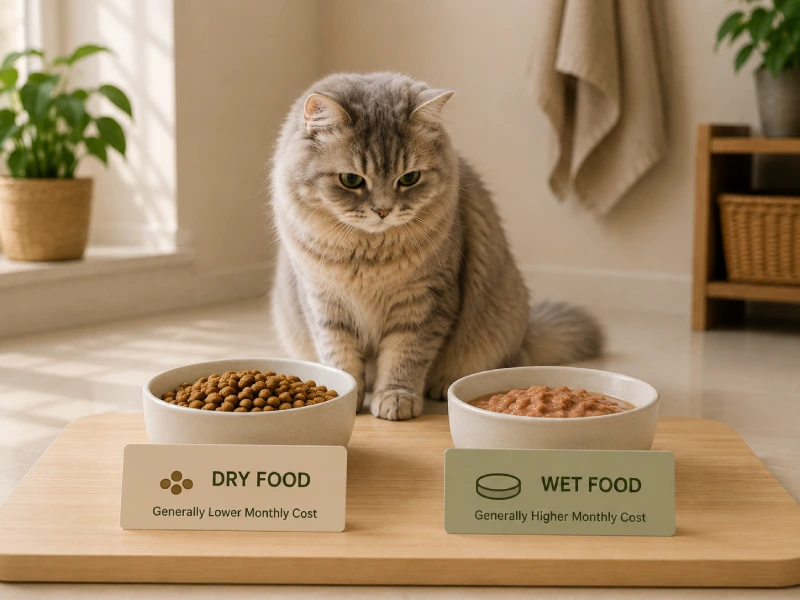
The single largest driver of monthly variation. The range reflects food type choice — dry food sits at the lower end, wet food at the higher end, mixed feeding somewhere between. Cat size matters too, but less than food format. Your food type decision is the most direct lever you have over monthly food costs, which is worth knowing before you make it.
Litter: $10–$30/month
Determined primarily by the litter type you chose and how frequently full replacement happens. Clumping litter typically costs less per month than non-clumping because only the soiled portion is removed rather than the full contents — but the gap narrows depending on the specific products and box setup you use.
Parasite prevention: $10–$20/month
Flea, tick, and worm prevention products vary by type and whether they’re prescribed versus over-the-counter. This is a consistent monthly line item for most cat owners, not an occasional expense.
Total monthly estimate: $35–$110/month
For most single-cat households after the startup period. The lower end reflects dry food and clumping litter; the upper end reflects wet-food-only feeding and more frequent litter replacement.
Planning implication: Monthly costs are the most predictable category — once your cat’s routine is established, your actual monthly spend will be clear within two to three months. The most important thing to know before adoption: your food type choice is the single decision that most affects how much you spend every month, and it’s a decision you’re making anyway.
Annual and Irregular Costs: What to Plan For Each Year
These costs happen less frequently than monthly expenses but need a place in your overall financial planning — particularly because some of them are unpredictable in timing, even when they’re predictable in amount.
Annual wellness vet visit: $50–$150+
The routine annual checkup varies significantly by location — vet costs in larger cities tend to run higher than in smaller markets. Plan for this as a scheduled expense at the start of each year, not as a cost that might or might not happen.
Vaccinations: Often bundled into the annual visit; cost varies by which vaccines are current and what your vet’s protocol includes. Not a separate budget line in most cases.
Professional grooming (if applicable): $30–$80 per session
Long-haired cats occasionally benefit from professional grooming; short-haired cats rarely require it. If your cat has a long coat and you’re not managing it fully through home grooming, one to two professional sessions per year is a reasonable planning estimate.
Pet insurance (optional): $15–$50/month
If you choose it. Pet insurance is a financial risk management decision, not a standard ownership requirement — whether it makes sense depends on your financial situation, your cat’s breed health history, and your comfort with unpredictable vet bills. It’s worth understanding as an option, not assuming it’s necessary.
Emergency or contingency fund: $500–$1,000 as a planning target
Not because something is likely to go wrong, but because having this buffer means an unexpected vet visit doesn’t become a financial crisis. The most practical way to build it: set aside $20–$40 per month from the start, and don’t think of it as cat money you might spend — think of it as insurance you’re self-funding.
Planning implication: Annual costs divide into predictable (routine vet visit, any scheduled grooming) and genuinely unpredictable (unexpected health issues). The practical approach is to treat the predictable ones as scheduled annual expenses and build toward an emergency buffer through small monthly contributions — rather than either ignoring unpredictable costs entirely or letting them feel like financial emergencies when they arrive.
What Does Cat Ownership Actually Cost Per Month?
With all three cost categories understood, here’s what the full picture looks like on a monthly basis.
Monthly recurring costs come to $35–$110 for most single-cat households. Annual and irregular costs — when divided by twelve — add roughly $15–$40 per month in equivalent terms (covering the routine vet visit, any grooming, and contributions toward an emergency buffer).
Total realistic monthly range: $50–$150/month after the startup period, for a single cat in most households.
Four things determine where you land within that range: your food type choice (the biggest single variable, and one you control); whether you carry pet insurance; your location (vet costs vary meaningfully by city and region); and your cat’s individual health and coat needs.
Most first-time cat owners find their actual monthly spend settles in the lower half of this range once the routine is established. The upper end applies to owners feeding primarily wet food, carrying pet insurance, and living in higher cost-of-living areas. Neither end reflects better or worse cat ownership — they reflect different choices, and different cats.
How to Budget for Cat Ownership Before You Bring Your Cat Home
Once you have a realistic picture of what to expect, the next step is turning that picture into a plan.
- Separate startup from recurring — treat them as two distinct budgets. Startup is a one-time investment that ends. Recurring is what ownership costs month to month, and it’s the number that matters for long-term financial planning. Mixing them inflates the apparent monthly cost and makes ownership seem more expensive than it is on an ongoing basis.
- Estimate your monthly recurring costs before adoption, not after. Food type and litter type choices drive the majority of monthly spend. Making those decisions with cost in mind — before your cat arrives — means you’re not discovering your monthly spend after you’ve already committed to a feeding approach that doesn’t fit your budget.
- Set aside a monthly buffer from the start. Even $20–$30 per month into a dedicated account means that an unexpected vet visit in month four or five doesn’t require a financial scramble. Starting the buffer from day one, rather than waiting until something happens, is the difference between an emergency feeling managed and an emergency feeling like a crisis.
- Track your actual spending for the first three months. Your cat’s real consumption patterns — how much food they eat, how quickly they go through litter — will tell you more about your actual monthly cost than any estimate. After three months, you’ll have enough real data to know whether your budget needs adjustment and where.

The goal of budgeting for cat ownership isn’t to find the cheapest way to do it — it’s to go in knowing what to expect so that the costs feel planned rather than surprising. Ownership costs that feel planned are easier to sustain consistently, which is better for both your finances and your cat.