Some links on this page are affiliate links. If you purchase through them, FirstPawGuide may earn a commission at no additional cost to you. Recommendations are based on editorial evaluation and are not influenced by affiliate partnerships.
Best Cat Brush for First-Time Owners: Which Type Fits Your Cat’s Coat?
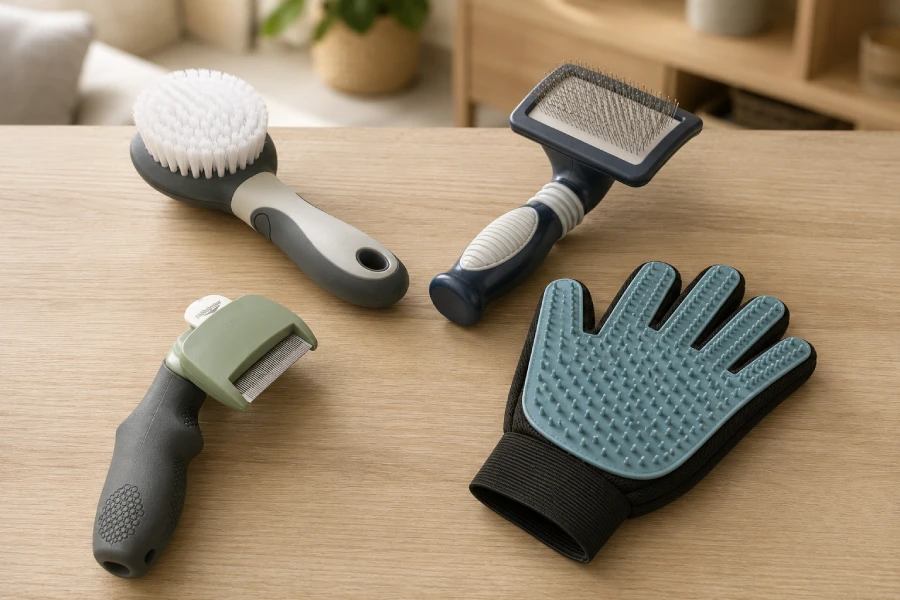
There’s no single best cat brush for every cat — the right type depends on your cat’s coat length, how much they shed, and how often you plan to groom. This guide helps you choose based on your cat’s specific coat scenario, not based on which brush has the most features. Four main types are covered: bristle brushes, slicker brushes, deshedding tools, and rubber grooming gloves. Your cat’s coat type is the starting point — not the brush.
For a broader overview of everything to set up before your cat arrives, the complete first-time cat owner guide covers grooming setup alongside every other essential decision.
What This Guide Covers
- Four brush types — bristle, slicker, deshedding tool, and rubber glove — each match a different coat scenario, not a single “best” brush for every cat.
- Coat length, shedding level, and your cat’s current tolerance for touch are the three attributes that determine which brush will actually get used consistently.
- The quick decision guide at the end matches your cat’s coat scenario to the right starting brush, with room to add a more specialized tool later.
What Makes a Good Cat Brush for a First-Time Owner?
Before getting into coat-specific recommendations, here are seven criteria worth considering. These aren’t product specifications — they’re decision attributes that will help you evaluate which type genuinely fits your cat.
- Coat length match — the brush needs to suit the coat it’s working through; a brush designed for long coats used on a short-haired cat won’t accomplish anything useful, and vice versa
- Shedding level — how much loose fur your cat produces determines whether a basic brush is sufficient or whether a more targeted tool is needed
- Pin or bristle stiffness — softer pins work for sensitive skin or fine coats; firmer bristles or wire pins are needed for denser or longer coats that require more penetration to be effective
- Handle comfort — you’ll be holding this regularly; an uncomfortable handle makes grooming sessions shorter than they need to be
- Ease of cleaning — fur accumulates in brush bristles quickly; a brush that’s difficult to clean gets used less consistently over time
- Size relative to your cat — a brush that’s too large is harder to maneuver around legs, face, and tail; one that’s too small makes grooming take longer than it should
- Your cat’s current tolerance for touch — some cats accept grooming readily, others need a gradual introduction; the right brush for a touch-tolerant cat may be too intense for one that isn’t yet comfortable being handled
Focus on coat length, shedding level, and your cat’s current tolerance first — these three determine whether the brush you choose will actually get used consistently.
Best Cat Brush for Short-Haired Cats
Works well if
- Your cat has a short, smooth coat with minimal undercoat
- You want a low-maintenance tool that’s quick to use and easy to clean
- Your cat is still getting used to being groomed — the glove format is an easier introduction
Less suitable if
- Your cat turns out to shed more than expected or has a dense undercoat — these tools don’t reach it
Short-haired cats still shed and still benefit from regular brushing — they just need a simpler tool than a long-coated cat does, and the wrong brush for a short coat won’t add anything useful to the session.
A bristle brush or rubber grooming glove fits this coat scenario best. A bristle brush works the surface of a short, smooth coat effectively — lifting loose fur and surface debris with a motion most cats tolerate well. A rubber grooming glove takes a slightly different approach: the soft rubber nubs lift loose fur as you run your hand across the coat in a motion that resembles petting. For short-haired cats being introduced to grooming for the first time, the glove format is often easier to accept than a brush because the contact feels more familiar. Both work well for this coat type — the choice between them comes down to which your cat accepts more readily.
One trade-off to understand: bristle brushes and rubber grooming gloves don’t reach into a dense undercoat — they work the surface and remove loose fur, but won’t address undercoat buildup if your cat has one. If your short-haired cat turns out to shed more than expected, a bristle brush alone may not be sufficient.
Rubber grooming gloves work particularly well for cats that resist traditional brush contact — the glove format distributes pressure across the hand rather than concentrating it in bristles, which many cats find more acceptable.
Choose this if:
- Your cat has a short, smooth coat with minimal undercoat
- You want a low-maintenance grooming tool that’s quick to use and easy to clean between sessions
- Your cat is still getting used to being groomed — the glove format is often the easier introduction
- You groom weekly rather than daily and want a simple, consistent option that fits that frequency
![[Product Name] — bristle brush or rubber grooming glove](/assets/images/products/[bristle-brush-glove-product-image].webp)
[Product Name]
Best for: Short-haired cats and cats still getting used to grooming
[Reason — 1-2 sentences, decision-context framing]
Best Cat Brush for Long-Haired Cats
Works well if
- Your cat has a long coat that mats or tangles without consistent brushing
- You plan to groom several times per week to prevent mat formation
- Your cat is comfortable being handled for longer grooming sessions
Less suitable if
- The coat already has developed mats and you skip combing first — fine wire pins can cause discomfort on existing mats
Long-haired cats need more frequent brushing and a more targeted tool — not because their coat is inherently more difficult, but because long fur forms tangles and mats if left without attention in a way that short fur simply doesn’t.
A slicker brush fits this coat scenario best. The fine wire pins penetrate through layers of long fur to lift loose hair, surface debris, and early-stage tangles before they develop into harder mats. For a long-haired cat that’s groomed consistently several times per week, a slicker brush is the most effective tool for keeping the coat clear between sessions. Used before tangles develop, it keeps long-coat maintenance manageable rather than reactive. A pin comb or wide-tooth comb used before the slicker brush works through any existing tangles without pulling — making the slicker brush session shorter and more comfortable for your cat.
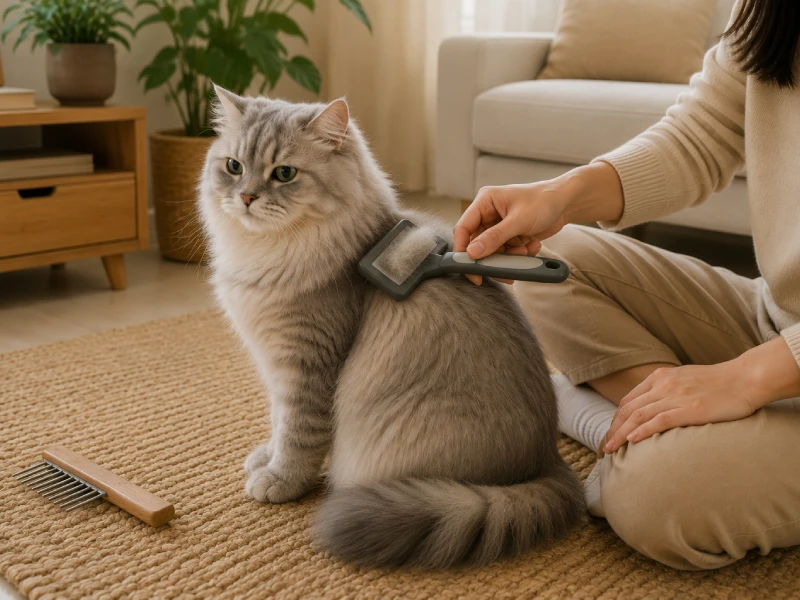
One trade-off to know: slicker brushes — particularly those with fine wire pins — can cause discomfort if applied with too much pressure or used on a coat that already has developed mats. Starting with a wide-tooth comb to clear tangles before using the slicker brush prevents the most common source of grooming resistance in long-haired cats. The sequence matters: comb first, then brush.
A pin comb or wide-tooth comb used before the slicker brush clears tangles without pulling — making the slicker brush pass shorter and more effective for both of you.
Choose this if:
- Your cat has a long coat that mats or tangles without consistent brushing
- You plan to groom several times per week to prevent mat formation before it starts
- Your cat is comfortable being handled for longer grooming sessions
- You want the most effective tool for maintaining a long coat with minimal mat development over time
![[Product Name] — slicker brush for long-haired cats](/assets/images/products/[slicker-brush-product-image].webp)
[Product Name]
Best for: Long-haired cats groomed several times a week to prevent mats
[Reason — 1-2 sentences, decision-context framing]
Best Cat Brush for Heavy Shedders and Double-Coated Cats
Works well if
- Your cat has a double coat or dense undercoat that a standard brush doesn’t reach
- Your cat sheds heavily — noticeably more than a standard bristle brush can manage
- You’re willing to use it at the recommended frequency — once or twice per week
Less suitable if
- You plan to use it daily or with heavy pressure — this can irritate skin or damage the topcoat
- Your cat has a single, short coat — a deshedding tool isn’t designed for this and offers no benefit
If your cat has a double coat or a dense undercoat — or sheds heavily enough that a standard brush isn’t keeping up in a single session — this is a coat scenario with a specific constraint: a standard brush isn’t designed to reach the undercoat that’s the primary source of the shedding.
A deshedding tool fits this coat scenario not because it’s a superior brush type in general, but because it’s the only tool designed specifically to reach and remove loose fur from the undercoat layer. For cats with double coats — breeds like Maine Coon, Ragdoll, or any cat with a noticeably thick, layered coat — the volume of loose undercoat produced during shedding season exceeds what a bristle or slicker brush can manage effectively. A deshedding tool’s fine comb edge works through the topcoat to lift and remove loose undercoat fur before it ends up on your furniture and clothing. If your cat has a double coat or sheds heavily enough that a standard brush isn’t keeping up, a deshedding tool is designed for that specific coat condition.
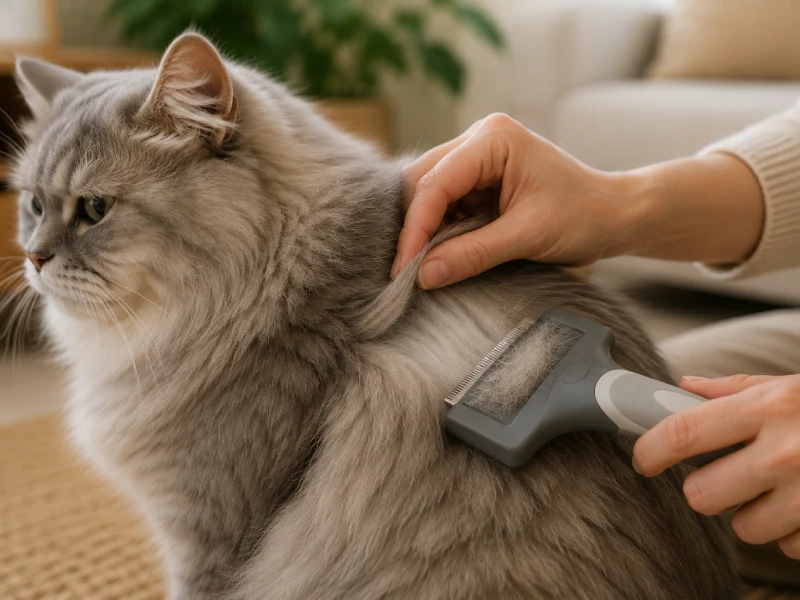
One trade-off to understand before using this type: deshedding tools are designed to reach and remove undercoat — used too frequently or with too much pressure, they can irritate skin or damage the topcoat. Most deshedding tools are recommended for use once or twice per week during shedding season, not as a daily grooming tool.
Deshedding tools use a fine-edged comb to reach the undercoat without cutting the topcoat — effectiveness depends on the coat being dry and tangle-free before use.
Choose this if:
- Your cat has a double coat or dense undercoat that a standard brush doesn’t reach effectively
- Your cat sheds heavily — noticeably more than a standard bristle brush can manage in one session
- Shedding season produces a significant increase in loose fur around your home that standard brushing doesn’t address
- You’re willing to use it at the recommended frequency — once or twice per week — rather than daily
![[Product Name] — deshedding tool for double-coated cats](/assets/images/products/[deshedding-tool-product-image].webp)
[Product Name]
Best for: Double-coated cats that shed heavily during shedding season
[Reason — 1-2 sentences, decision-context framing]
Best Cat Brush for Cats with Sensitive Skin or Low Grooming Tolerance
Works well if
- Your cat flinches, moves away, or resists grooming with a standard brush
- You’re introducing grooming to a newly adopted cat and want the lowest-friction starting point
- Your cat’s coat is short enough that a gentle brush covers its actual grooming needs
Less suitable if
- Your cat has a long or thick coat alongside low grooming tolerance — soft tools work the surface only and won’t penetrate effectively
Some cats — particularly newly adopted ones or those that haven’t been groomed regularly before — show clear resistance when you attempt brushing: pulling away, flinching, or refusing to stay still. For this scenario, the brush type matters more than the technique.
A soft bristle brush or rubber grooming glove in a gentle format fits this situation best. It gives you the lowest-friction entry point for building a grooming routine without triggering the resistance that makes future sessions harder to establish. A soft bristle brush uses bristles that don’t press into skin the way wire pins do — more acceptable for cats that react to firmer brush contact. A rubber grooming glove with soft nubs distributes pressure across a wider surface area than any brush does, which many cats that resist focused bristle contact will accept more readily. For a cat that’s new to your home or new to grooming, starting with the gentlest available tool is the practical decision that makes consistent grooming easier to build over time.
One trade-off to be clear about: soft bristle brushes and rubber gloves won’t penetrate a dense or long coat effectively — they work the surface only. If your cat has a long or thick coat alongside low grooming tolerance, you’ll need to build toward a more effective tool gradually rather than starting with one.
A rubber grooming glove with soft nubs distributes pressure across a wider area than a brush — often more acceptable for cats that react to the focused contact of bristles.
Choose this if:
- Your cat flinches, moves away, or shows clear resistance when you attempt grooming with a standard brush
- You’re introducing grooming to a newly adopted cat and want the lowest-friction starting point available
- Your cat’s coat is short enough that a gentle brush covers its actual grooming needs
- You plan to build toward more thorough grooming gradually as your cat becomes comfortable with regular sessions
![[Product Name] — soft bristle brush or gentle rubber grooming glove](/assets/images/products/[gentle-brush-glove-product-image].webp)
[Product Name]
Best for: Cats that resist standard brush contact or are new to grooming
[Reason — 1-2 sentences, decision-context framing]
Best Cat Brush If Budget Is a Primary Consideration
Works well if
- You’re managing multiple startup costs simultaneously
- Your cat’s coat type or shedding level isn’t yet clear
- You plan to reassess after the first few months once the pattern is clearer
Less suitable if
- Your cat turns out to be a heavy shedder with a double coat — a basic brush or glove won’t address undercoat buildup effectively
If you’re managing multiple startup purchases at once, choosing a functional brush without specialized features is a practical and entirely reasonable decision.
A basic bristle brush or rubber grooming glove at a lower price point works reliably and is straightforward to maintain. No mechanism to wear out, no components to replace, and no technique requirements beyond what any cat owner can manage in the first weeks. Starting with a basic option also gives you the opportunity to observe your cat’s actual coat and shedding behavior before investing in a more targeted tool — in the first days of ownership, you may not yet know how much your cat sheds, whether they have a dense undercoat, or how they’ll respond to grooming. That information is worth having before you buy something more specialized. Estimated cost: $8–$20 for a basic bristle brush or rubber grooming glove, depending on brand and where you shop. Prices vary by region and retailer.
One trade-off to understand: a basic bristle brush or rubber glove won’t address dense undercoat or heavy shedding effectively — if your cat turns out to be a heavy shedder with a double coat, you’ll need a more targeted tool. But that’s useful information to gather first rather than assume.
A basic rubber grooming glove at a lower price point also works as a lint-removal tool for furniture — a practical secondary use during the first weeks of cat ownership.
Choose this if:
- You’re managing multiple startup costs simultaneously in your first month of cat ownership
- Your cat’s coat type or shedding level isn’t yet clear — you haven’t had them long enough to observe the full pattern
- A basic grooming tool covers your cat’s short coat needs without requiring anything more specialized
- You plan to reassess after the first few months once you have a clearer picture of your cat’s coat and shedding behavior
![[Product Name] — basic bristle brush or rubber grooming glove](/assets/images/products/[budget-brush-product-image].webp)
[Product Name]
Best for: First-time owners managing multiple startup costs at once
[Reason — 1-2 sentences, decision-context framing]
How to Introduce and Use Any Cat Brush Correctly
The right brush used badly produces worse results than a basic brush used well. These steps apply to every type covered in this article.
- Introduce the brush before the first grooming session — let your cat sniff and investigate it at their own pace before you use it on them
- Start with short sessions — two to three minutes is enough for a first introduction; build duration gradually as your cat becomes comfortable with the routine
- Brush in the direction of coat growth — brushing against the coat direction causes discomfort and increases resistance for most cats
- Check for mats or tangles before brushing — working a brush through an existing mat causes pulling; work through tangles by hand or with a wide-tooth comb before starting the brush session
- Clean the brush after each session — accumulated fur in bristles reduces effectiveness and makes the next session less comfortable for your cat
- Keep sessions consistent — a brief regular brushing session is more effective for coat maintenance than an infrequent longer one
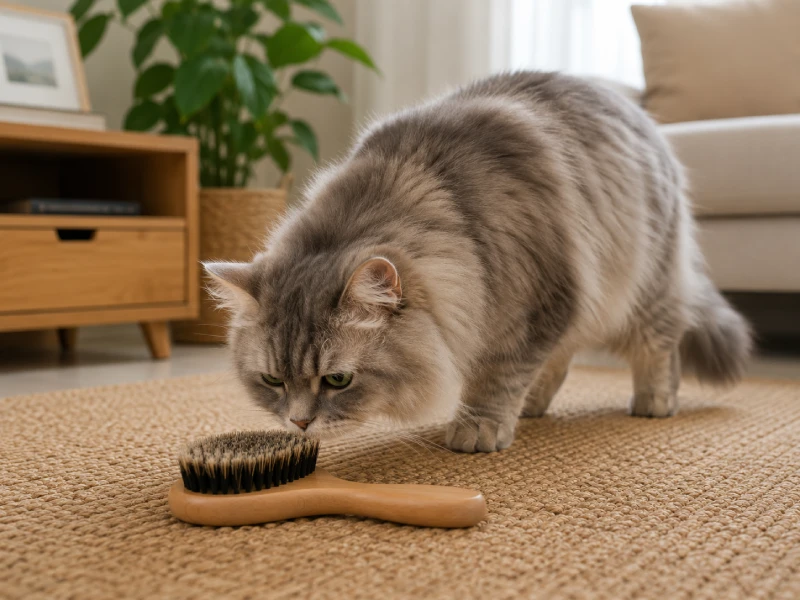
If your cat consistently resists grooming, reassess the brush type before you reassess the session length. The wrong brush for the coat type or the cat’s tolerance level is usually the issue — not the cat.
Which Cat Brush Should You Buy? A Quick Decision Guide
Choose the coat scenario that sounds most like your cat’s — not the brush with the most features.
Quick Decision Guide
If Your Cat Has a Short Coat…
Bristle brush or rubber grooming glove. Both work well for short, smooth coats — choose the rubber glove if your cat is new to grooming or resists brush contact, the bristle brush if they’re already comfortable being handled.
If Your Cat Has a Long Coat…
Slicker brush, with a wide-tooth comb as a secondary tool for tangles. Use the comb first to clear any knots, then follow with the slicker brush. Consistency matters more than session length for long-coat maintenance.
If Your Cat Is a Heavy Shedder…
Deshedding tool — but only if your cat has a double coat or dense undercoat that a standard brush can’t reach effectively. Not a recommendation for every cat; only for this specific coat condition.
If Your Cat Has Sensitive Skin…
Soft bristle brush or rubber grooming glove in a gentle format. The lowest-friction starting point for grooming — build toward a more effective tool gradually as your cat becomes comfortable with regular sessions.
If Budget Comes First…
Basic bristle brush or rubber grooming glove. Functional, easy to maintain, and a sensible starting point before investing in a more specialized type once you know your cat’s actual coat and shedding pattern.
Ready to continue your setup? Return to the new cat checklist to work through the remaining supply categories before your cat arrives.