Some links on this page are affiliate links. If you purchase through them, FirstPawGuide may earn a commission at no additional cost to you. Recommendations are based on editorial evaluation and are not influenced by affiliate partnerships.
Best Cat Carrier for First-Time Owners: Which Type Fits Your Transport Needs?
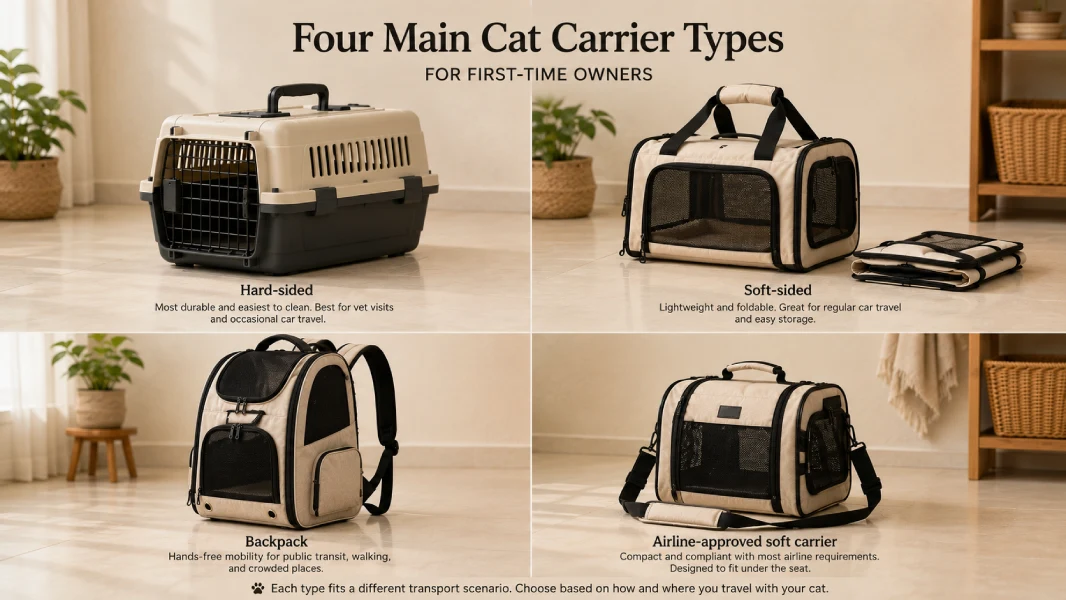
There’s no single best cat carrier for every situation — the right type depends on how often you’ll be transporting your cat, where you’re going, and how you’re getting there. This guide helps you choose based on your specific transport scenario, not based on which carrier has the most features. Four main types are covered: hard-sided, soft-sided, backpack, and airline-approved. For most first-time cat owners, the first transport need is the same: getting your cat to the vet. From there, frequency and mode of transport determine which type fits best.
For a broader overview of everything to set up before your cat arrives, the complete first-time cat owner guide covers carrier selection alongside every other essential decision.
What This Guide Covers
- Four carrier types — hard-sided, soft-sided, backpack, and airline-approved — each fit a different transport scenario, not a single “best” carrier for every trip.
- Frequency and mode of transport (car, on foot, transit, or air) determine the right type more than features or price.
- The quick decision guide at the end matches your most common transport scenario to the right starting carrier, with room to add a second type later.
What Makes a Good Cat Carrier for a First-Time Owner?
Before getting into scenario-specific recommendations, here are seven criteria worth considering. These aren’t product specifications — they’re decision attributes that will help you evaluate which type fits your transport needs best.
- Size relative to your cat — the carrier should allow your cat to stand, turn around, and lie down comfortably; too large is as problematic as too small for stability during transport
- Ventilation — adequate airflow on at least two sides; mesh panels are the standard for soft-sided carriers, grille openings for hard-sided
- Security — latches, zippers, and closures must hold under movement and if your cat pushes against them from inside; test before the first use
- Ease of loading — how your cat enters and how you manage the process; a top-entry opening makes loading significantly easier for cats that resist walking in through a front opening
- Weight when empty — relevant if you carry the carrier on public transit or for any distance on foot; hard-sided carriers are heavier than soft-sided at the same internal capacity
- Storage footprint — collapsible soft-sided carriers and backpacks store flat; hard-sided carriers require dedicated storage space year-round
- Cleanability — accidents happen during transport; removable liners or smooth interior surfaces are easier to clean than fabric-only interiors
Focus on size, security, and transport mode compatibility first — these three determine whether the carrier is safe and usable in your specific scenario.
Best Cat Carrier for Vet Visits and Occasional Use
Works well if
- Your primary use is vet visits and occasional car trips a few times per year
- You want the most durable, easiest-to-clean option for infrequent use
- Storage space for a rigid carrier isn’t a constraint in your home
Less suitable if
- You need to carry the carrier on foot or public transit — hard-sided is heavier at the same capacity
- You need it to fold flat for storage — hard-sided carriers don’t collapse
For most first-time cat owners, this is the primary scenario: vet visits a few times a year, car transport, no other significant transport need.
A hard-sided carrier fits this situation best. The rigid structure holds its shape reliably under car transport conditions and doesn’t require any special preparation between uses. The smooth interior is straightforward to clean after an accident — wipe down and it’s ready for next time. For vet visits that happen a few times a year by car, this is the most direct choice: no assembly required, no structural collapse concerns, no special transport compatibility to verify before you leave the house.
One trade-off to understand before choosing this type: hard-sided carriers don’t collapse for storage — they require dedicated space in a closet or garage year-round. They’re also heavier than soft-sided carriers at the same internal capacity, which matters if you ever need to carry the carrier any distance on foot.
Most hard-sided carriers use front entry; a model with a top-loading option or a removable top panel makes loading significantly easier if your cat resists walking in through the front opening.
Choose this if:
- Your primary use is vet visits and occasional car trips — a few times per year
- You want the most durable and easiest-to-clean option for infrequent use
- Storage space for a rigid carrier is not a constraint in your home
- You transport your cat by car rather than on foot or public transit
![[Product Name] — hard-sided cat carrier](/assets/images/products/[hard-sided-carrier-product-image].webp)
[Product Name]
Best for: Occasional vet visits and car transport a few times a year
[Reason — 1-2 sentences, decision-context framing]
Best Cat Carrier for Regular Car Travel
Works well if
- You travel by car with your cat monthly or more frequently
- You want a lighter carrier that’s easier to move between car and destination
- You’ll verify seatbelt compatibility before purchasing
Less suitable if
- The model isn’t crash-tested or has no seatbelt pass-through — a carrier that slides during braking is a safety issue
If you travel by car with your cat regularly — monthly or more often, road trips, or multi-destination travel — the demands on a carrier shift from “functional for occasional use” to “works well in a car context consistently.”
A soft-sided carrier with a seatbelt loop or crash-tested design fits this situation best. It gives you the balance between ease of repeated use and the in-car security that matters when you’re transporting your cat frequently. A lighter carrier is easier to move between car and destination, and most soft-sided models fold flat when not in use — reducing storage demands between trips. For regular travel, ease of repeated use becomes a more important attribute than durability for single use.
One trade-off worth knowing: soft-sided carriers are less structurally rigid than hard-sided — and not all models are crash-tested or designed for secure in-car placement. Look for a carrier with a seatbelt pass-through or loop before buying; a carrier that slides during braking is a safety issue, not just an inconvenience.
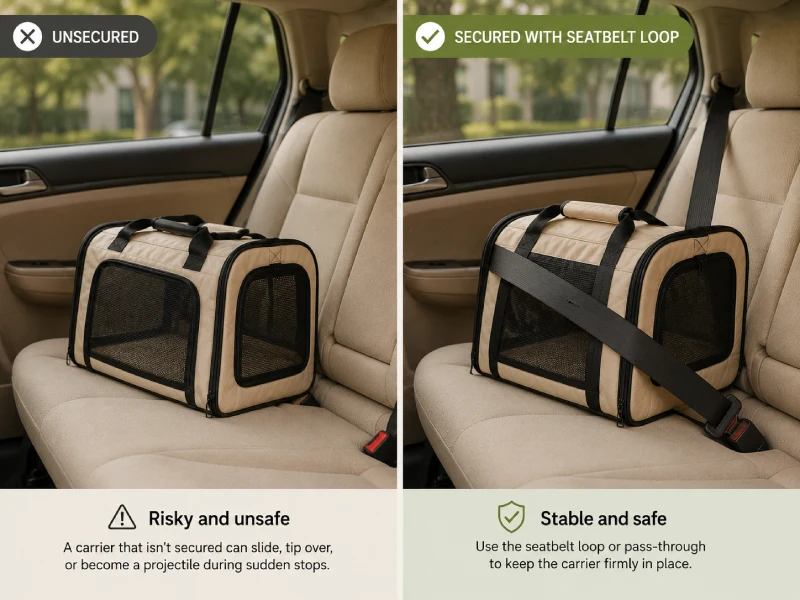
Soft-sided carriers typically offer both front and top entry — top entry is useful for cats that are reluctant to walk in on their own.
Choose this if:
- You travel by car with your cat monthly or more frequently
- You want a lighter carrier that’s easier to move between car and destination
- Storage is a consideration — most soft-sided carriers fold flat when not in use
- You prioritize in-car security and will verify seatbelt compatibility before purchasing
![[Product Name] — soft-sided cat carrier with seatbelt loop](/assets/images/products/[soft-sided-carrier-product-image].webp)
[Product Name]
Best for: Owners who travel by car with their cat monthly or more often
[Reason — 1-2 sentences, decision-context framing]
Best Cat Carrier for Public Transit and Walking
Works well if
- You don’t have a car and use public transit or walk to vet appointments
- You need both hands free — on stairs, escalators, or crowded transit
- Your cat is within typical backpack weight limits (around 15–18 lbs) and trips are short
Less suitable if
- Your cat is larger than typical backpack carrier limits
- Trips are longer than one to two hours — internal volume and ventilation are more limited than conventional carriers
If you don’t have a car and rely on public transit or walking to get to vet appointments — a common situation for cat owners in cities — a conventional carrier held in one hand becomes a real liability on escalators, stairs, or crowded vehicles.
A backpack carrier fits this situation best. It distributes your cat’s weight across both shoulders and keeps both hands free throughout the journey. On stairs, escalators, or packed transit cars, having both hands available isn’t just more comfortable — it’s a meaningful practical difference in how safely and easily you can navigate. For urban cat owners who depend on transit or walking, a backpack carrier removes the primary friction from every transport trip.

One trade-off to factor in: backpack carriers have less internal volume than conventional carriers of similar external dimensions — not suitable for larger cats or for trips longer than one to two hours. Ventilation design also varies significantly between models; inadequate airflow in an enclosed backpack is a genuine concern for longer journeys, not just a minor inconvenience.
Most backpack carriers load from the top or a side panel — check the opening size relative to your cat before buying.
Choose this if:
- You don’t have a car and use public transit or walk to vet appointments
- You need both hands free during transport — on stairs, escalators, or crowded transit
- Your cat is within the weight and size limits for backpack-style carriers (typically up to 15–18 lbs for most models)
- Trips are short — vet visits or similar durations, not multi-hour travel days
![[Product Name] — backpack cat carrier](/assets/images/products/[backpack-carrier-product-image].webp)
[Product Name]
Best for: Urban owners without a car who walk or use transit to vet visits
[Reason — 1-2 sentences, decision-context framing]
Best Cat Carrier for Air Travel
Works well if
- You need to travel by air with your cat in the cabin, not cargo
- You’ve confirmed your airline allows cats in-cabin and checked their specific size and weight requirements
- Your cat’s size fits within airline-compliant carrier dimensions comfortably
Less suitable if
- Your cat is larger and would feel cramped in under-seat dimensions on a long flight
- You haven’t yet verified the specific carrier model against your airline’s policy
If you need to fly with your cat in the cabin — not cargo — this is a scenario defined by one constraint that can’t be negotiated around: the carrier must meet your airline’s specific cabin dimensions. Every other decision follows from that.
An airline-approved soft-sided carrier that meets cabin dimensions fits this situation — not because this type is inherently better than others, but because it’s the only type that fits under the seat in front of you. Before purchasing anything, verify your specific airline’s requirements: size limits, weight limits, and in-cabin pet policies vary by airline and by route. A carrier that meets one airline’s specifications may not meet another’s. Start with the constraint, then find a carrier that satisfies it.
The trade-off is built into the constraint itself: airline-approved carriers are sized to fit under an aircraft seat, which makes them smaller than what many cats would use for ground transport. A carrier that meets airline dimensions may feel cramped for a larger cat on a long flight — factor your cat’s size into the decision alongside the airline’s requirements.
Soft-sided airline carriers typically use front or top entry — verify the opening configuration before buying if your cat needs top loading.
Choose this if:
- You need to travel by air with your cat in the cabin, not cargo
- You’ve confirmed your airline allows cats in-cabin and checked their specific size and weight requirements
- Your cat’s size fits within airline-compliant carrier dimensions comfortably
- You’ve verified the specific carrier model against your airline’s policy before purchasing
![[Product Name] — airline-approved soft-sided cat carrier](/assets/images/products/[airline-approved-carrier-product-image].webp)
[Product Name]
Best for: Owners flying with their cat in-cabin who have confirmed their airline’s requirements
[Reason — 1-2 sentences, decision-context framing]
Best Cat Carrier If Storage Space Is Limited
Works well if
- You live in a studio or small apartment with limited dedicated storage space
- You use the carrier infrequently but need it to store flat between uses
- You’re comfortable assembling the carrier before each use
Less suitable if
- Emergency readiness is a primary concern and you won’t keep it partially assembled — assembly takes time you may not have
If you live in a studio or small apartment where a rigid carrier sitting in a closet year-round isn’t realistic — but you still need a functional carrier for vet visits — there’s a type that solves both problems at once.
A collapsible soft-sided carrier or collapsible backpack carrier fits this situation best. It folds flat when not in use and stores on a shelf, in a drawer, or behind a door without taking up meaningful dedicated space. For cat owners who use a carrier infrequently but need to store it in a limited footprint, this removes the main friction of carrier ownership without giving up functionality. This scenario can also overlap with occasional use or transit — if you have two needs at once, a collapsible option covers both without requiring a separate purchase.
One trade-off to know upfront: collapsible carriers require assembly before each use — minor friction that becomes relevant in an emergency when you need the carrier immediately. Keep it partially assembled or in an easily accessible location if emergency use is a realistic scenario for you.
Collapsible soft-sided carriers typically offer front and top entry — the same as standard soft-sided models.
Choose this if:
- You live in a studio or small apartment with limited dedicated storage space
- You use the carrier infrequently — primarily vet visits — but need it to store flat between uses
- You’re comfortable assembling the carrier before each use
- Emergency readiness is not a primary concern, or you’ll keep it partially assembled in an accessible spot
![[Product Name] — collapsible soft-sided cat carrier](/assets/images/products/[collapsible-carrier-product-image].webp)
[Product Name]
Best for: Small apartments where year-round dedicated storage isn’t realistic
[Reason — 1-2 sentences, decision-context framing]
How to Set Up and Introduce Any Cat Carrier Correctly
Getting the carrier ready for use isn’t just about taking it out of the box the day you need it. These steps apply to every type covered in this article.
- Set up the carrier in your home before the first use — leave it accessible with the door open so your cat can explore it at their own pace before they need to be inside it
- Place a worn piece of your clothing or your cat’s familiar bedding inside — familiar scent reduces resistance when it’s time to load
- Don’t use the carrier only for stressful events — placing treats or a meal near or inside the carrier occasionally builds a neutral association over time, so the carrier isn’t only associated with being taken somewhere
- Practice loading before the first real trip — a short session at home is far less disruptive than discovering a loading problem in the car park before a vet appointment
- Secure the carrier during transport — on the car seat with a seatbelt loop, on a stable surface in transit, or worn securely as a backpack; a carrier that slides or shifts increases both stress and safety risk
- Keep the carrier accessible between uses — particularly relevant for emergencies; a carrier stored somewhere difficult to reach adds critical minutes when time matters
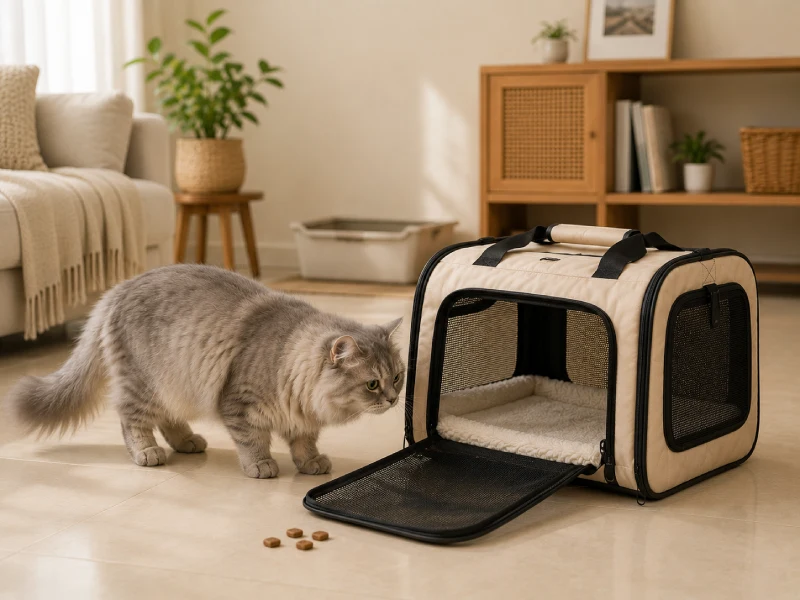
The goal of introducing the carrier isn’t training — it’s familiarity. A cat that has seen and entered the carrier before the first vet visit will be significantly easier to load than one encountering it for the first time under pressure.
Which Cat Carrier Should You Buy? A Quick Decision Guide
Choose the scenario that sounds most like yours — not the carrier with the most features.
Quick Decision Guide
If You Need It Mainly for Vet Visits…
Hard-sided carrier. Durable, easy to clean, and reliable for occasional car transport. The most straightforward choice for the most common first-time owner transport need — no assembly, no special compatibility to verify.
If You Travel by Car Regularly…
Soft-sided carrier with seatbelt compatibility. Lighter than hard-sided, folds flat for storage, and designed for repeated in-car use. Verify seatbelt pass-through before purchasing.
If You Use Public Transit or Walk…
Backpack carrier. Keeps both hands free during transport and distributes weight evenly. Best suited to short trips with a cat within the carrier’s weight limits.
If You Need to Fly with Your Cat…
Airline-approved soft-sided carrier. Verify your specific airline’s size and weight requirements before purchasing — policies vary by airline and route, and compliance is non-negotiable.
If Storage Space Is the Main Constraint…
Collapsible soft-sided or backpack carrier. Folds flat when not in use, removing the need for dedicated year-round storage space. Keep partially assembled if emergency access may be needed.
Ready to continue your setup? Return to the new cat checklist to work through the remaining supply categories before your cat arrives.