Some links on this page are affiliate links. If you purchase through them, FirstPawGuide may earn a commission at no additional cost to you. Recommendations are based on editorial evaluation and are not influenced by affiliate partnerships.
Best Cat Bed for First-Time Owners: Which Type Fits Your Cat and Space?
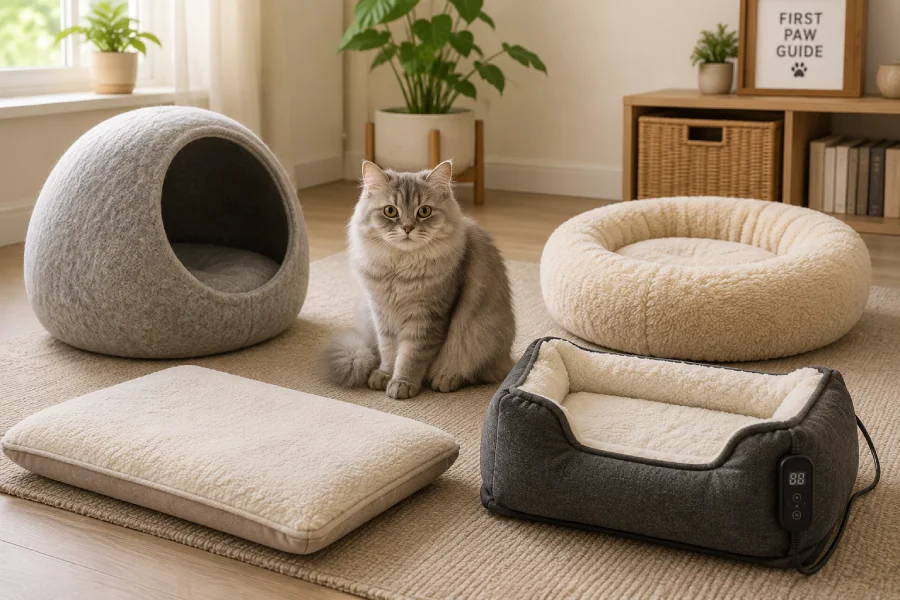
There’s no single best cat bed for every situation — the right type depends on how your cat likes to sleep and where the bed will fit in your home. This guide helps you choose based on your specific circumstances, not based on which bed has the most features or the highest price point. Four main types are covered: enclosed cave beds, open flat cushions, bolster and donut beds, and heated beds. Each one fits a different set of conditions.
For a broader overview of everything to set up before your cat arrives, the complete first-time cat owner guide covers bed selection alongside every other essential decision.
What This Guide Covers
- Four bed types — enclosed cave, open flat cushion, bolster/donut, and heated — each match a different sleeping style, not a single “best” bed for every cat.
- The bed type should follow your cat’s actual sleeping behavior, not the other way around — observation matters more than features or price.
- The quick decision guide at the end matches your cat’s sleeping style and your home to the right starting type, with room to adjust later.
What Makes a Good Cat Bed for a First-Time Owner?
Before getting into situation-specific recommendations, here are seven criteria worth considering. These aren’t product specifications — they’re decision attributes that will help you evaluate which type fits your cat and your home best.
- Size relative to your cat — the bed should allow your cat to stretch out fully or curl up comfortably, depending on how they actually sleep
- Sleeping style match — observe whether your cat curls tight, stretches out, or seeks enclosed spaces before buying; the bed type should follow the behavior, not the other way around
- Ease of cleaning — a removable cover or machine-washable material matters more than aesthetics for daily ownership; you’ll be washing this regularly
- Stability and placement — the bed should stay in place and fit the location you have in mind without sliding or taking up more floor space than you can spare
- Entry type — some cats step in from the side, others prefer to jump up onto a surface; enclosed beds require a cat confident enough to enter through a defined opening
- Budget range — cat beds range from under $15 to over $100; spending more doesn’t automatically mean a better fit for your specific cat’s preferences
- Your cat’s current behavior — a newly adopted cat may not use any bed immediately; placement and patience matter as much as the bed type itself
You don’t need to maximize every criterion at once. Focus on the attributes that matter most for your cat and your living situation.
Best Cat Bed If Your Cat Likes to Curl Up and Hide
Works well if
- Your cat consistently seeks out enclosed spaces — boxes, bags, under sofas
- Your home has higher foot traffic and your cat startles or retreats easily
- Your cat is newly adopted and still adjusting to the environment
Less suitable if
- Your cat hasn’t yet shown a clear preference for enclosed spaces — risk of a bed that goes unused
- Your cat actually prefers open sleeping — enclosed beds can feel too confining
Some cats consistently seek out enclosed spaces on their own — cardboard boxes, open bags, the space under furniture. That behavior is a clear signal about the bed type they’re most likely to actually use.
An enclosed or cave bed fits this situation best. The walls and roof create a defined, protected space on all sides — giving cats that prefer enclosure a resting spot that feels secure without forcing them to hide somewhere that wasn’t designed for it. For newly adopted cats still adjusting to a new home, an enclosed bed also provides one consistent place to retreat to, which can make the settling-in period quieter and less stressful for both of you.
One honest trade-off to understand before choosing this type: enclosed beds can feel too confining for cats that actually prefer open sleeping — and some cats never adapt to entering through a defined opening. If your cat hasn’t yet shown a clear preference for enclosed spaces, starting here means taking on the risk of a bed that goes unused entirely.
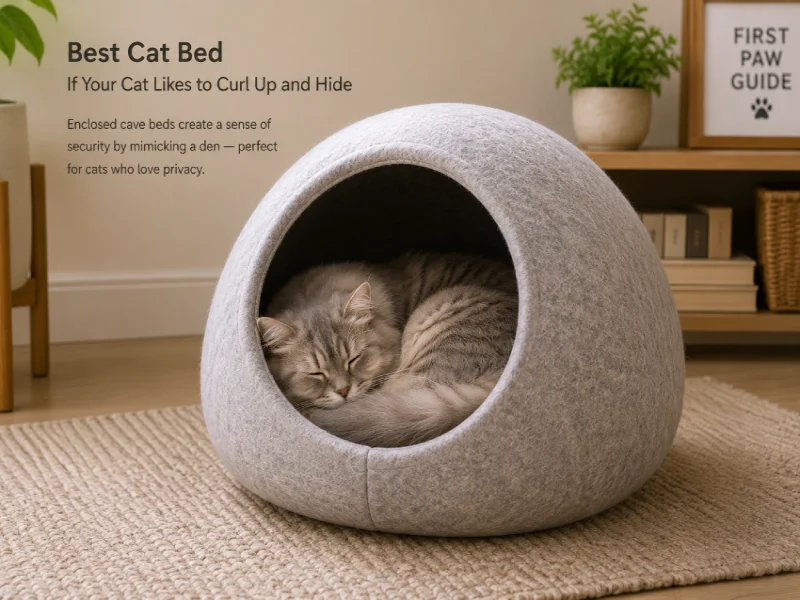
Choose this if:
- Your cat consistently seeks out enclosed spaces — boxes, bags, under sofas, or tight corners
- Your home has higher foot traffic and your cat startles or retreats easily
- The bed will be placed in a quieter area of your home
- Your cat is newly adopted and still adjusting to the environment
![[Product Name] — enclosed cave cat bed](/assets/images/products/[cave-bed-product-image].webp)
[Product Name]
Best for: Cats that consistently seek out enclosed, hidden spaces
[Reason — 1-2 sentences, decision-context framing]
Best Cat Bed for Open Sleepers and Relaxed Cats
Works well if
- Your cat regularly sleeps stretched out in open spaces — sofas, floors, windowsills
- You want the most flexible placement option
- Ease of washing is a top priority
Less suitable if
- Your home gets cold at night — open beds provide no insulation
- Your cat sometimes shows a preference for more sheltered resting spots
Cats that regularly sprawl across sofas, floors, or windowsills aren’t looking for boundaries or enclosure — they’re looking for a comfortable surface in the spots they’ve already chosen.
An open flat cushion or mat fits this situation best. It provides a soft, comfortable surface without restricting sleeping position or requiring any particular entry behavior. This is the most flexible type in terms of placement — it works on the floor, on a sofa, on a shelf, or on a windowsill, wherever your cat has already decided they like to rest. For cats that have already settled into your home and are showing relaxed, open sleeping behavior, a flat cushion is the most direct way to give them a designated comfortable spot without nudging them toward a behavior change they don’t need.
One trade-off to be aware of: open beds provide no insulation, no enclosure, and no raised edges — they’re the coldest option and offer no privacy for cats that occasionally want to retreat. If your home gets cold at night or your cat sometimes shows a preference for more sheltered resting spots, a flat cushion alone may not be enough.
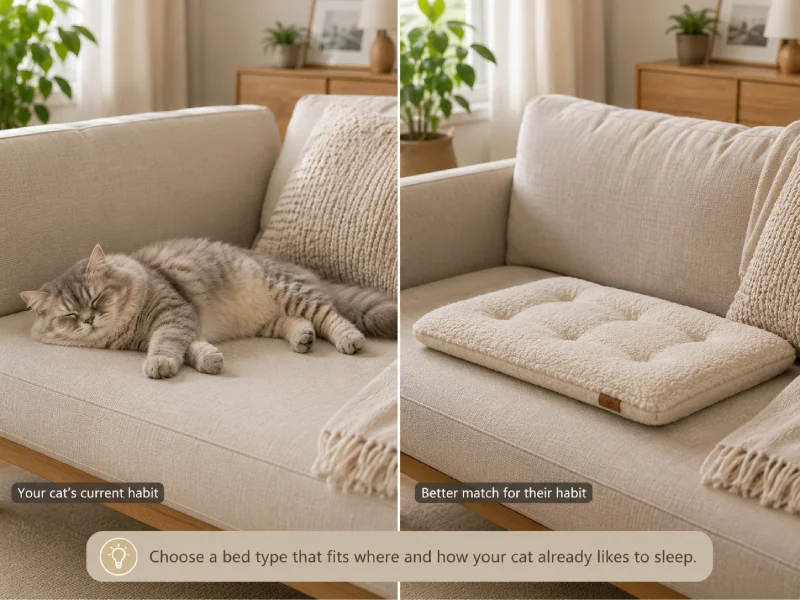
Choose this if:
- Your cat regularly sleeps stretched out in open spaces — on sofas, floors, or windowsills
- You want the most flexible placement option that can move with your cat’s preferred spots
- Ease of washing is a top priority — flat cushions are the simplest type to clean
- Your cat has already settled into the home and is showing relaxed, open sleeping behavior
![[Product Name] — open flat cushion cat bed](/assets/images/products/[flat-cushion-product-image].webp)
[Product Name]
Best for: Cats that already sleep stretched out in open spaces
[Reason — 1-2 sentences, decision-context framing]
Best Cat Bed If Your Cat Likes to Feel Surrounded
Works well if
- Your cat regularly rests with their chin or body pressed against a raised surface
- You want a sense of boundary without full enclosure
- Floor space isn’t a significant constraint in your home
Less suitable if
- You live in a very small apartment where every square foot is accounted for — bolster beds are bulkier and heavier than flat cushions
Some cats aren’t drawn to fully enclosed spaces, but they’re not comfortable sleeping on a completely open surface either — they want a sense of boundary around their body without a roof overhead.
A bolster or donut bed fits this situation best. The raised rim running around the edge of the bed gives cats a defined perimeter to rest against — the same kind of contact point that cats seek when they press their chin or body against a sofa armrest, a pillow edge, or your leg. Cats that consistently lean against raised surfaces while resting tend to take to this bed type more readily than either enclosed or open alternatives. This isn’t a compromise between enclosed and open — it’s a distinct option with its own use case and its own set of cats that genuinely prefer it.
One trade-off worth noting: bolster beds are bulkier and heavier than flat cushions, and they take up more floor space — not the ideal choice for very small apartments where every square foot is accounted for. Placement in a corner or alongside a sofa tends to work better than positioning them in open floor space.
Choose this if:
- Your cat regularly rests with their chin or body pressed against a raised surface — sofa arms, pillow edges, or your leg
- You want a bed that provides a sense of boundary without full enclosure
- Floor space isn’t a significant constraint in your home
- Your cat has already shown interest in beds or cushions that have a raised edge or defined perimeter
![[Product Name] — bolster donut cat bed](/assets/images/products/[bolster-bed-product-image].webp)
[Product Name]
Best for: Cats that like to lean against a raised edge while resting
[Reason — 1-2 sentences, decision-context framing]
Best Cat Bed for Cold Climates or Cats That Seek Warmth
Works well if
- Your home gets cold overnight or you don’t run heating through the night
- Your cat consistently gravitates toward warm spots — radiators, electronics, sunny patches
- You have a power outlet available if you want consistent active warmth from an electric bed
Less suitable if
- You have no power outlet near the intended placement and your home gets genuinely very cold — self-warming beds reflect warmth rather than generate it
- You want to avoid the added electricity cost and cord constraint of an electric heated bed
Cats that consistently migrate toward the warmest spots in the house — near radiators, on top of electronics, in patches of afternoon sunlight — are telling you exactly what they want from a resting spot.
A heated or self-warming bed is designed specifically for this situation. Two distinct approaches exist within this category and are worth distinguishing before you buy. Self-warming beds use heat-reflective material that captures and returns your cat’s own body heat — no cord, no electricity cost, no placement constraints beyond where the bed itself fits. Electric heated beds use an active heating element that requires a nearby power outlet and produces consistent warmth even in very cold environments. Both are valid choices; the decision between them comes down to how cold your home actually gets and whether a power outlet is available in your intended placement location.
The trade-off differs by type: electric heated beds require a cord and add to your electricity bill, and placement is constrained by cord length. Self-warming beds have no cord but provide less heat in genuinely cold environments — they work by reflecting warmth, not generating it. Choose based on your actual conditions, not on which option sounds more advanced.
Choose this if:
- Your home gets cold overnight or you don’t run heating through the night
- Your cat consistently gravitates toward warm spots — near radiators, on electronics, or in sunny patches
- You want a self-warming option with no cord and no added electricity cost
- You have a power outlet available in your intended placement location and want consistent active warmth
![[Product Name] — heated or self-warming cat bed](/assets/images/products/[heated-bed-product-image].webp)
[Product Name]
Best for: Cats that consistently seek out the warmest spot in the house
[Reason — 1-2 sentences, decision-context framing]
Best Cat Bed If Budget Is a Primary Consideration
Works well if
- You’re managing multiple startup costs simultaneously
- You want to observe your cat’s actual sleeping preferences before investing in a specialized type
- Your cat hasn’t yet shown clear preferences around warmth or enclosure
Less suitable if
- Your cat turns out to prefer warmth or enclosed spaces — a basic flat bed provides no insulation, no enclosure, and no raised edges
If you’re managing multiple startup purchases at once in the first month of cat ownership, choosing a functional bed without premium features is a practical and entirely reasonable decision.
A basic open cushion or flat mat works reliably and is straightforward to maintain. No mechanism to malfunction, no components to replace, no special placement requirements. Starting with a basic bed also gives you the opportunity to observe your cat’s actual sleeping preferences before committing to a more specialized type — many cats will choose to sleep somewhere unexpected regardless of what bed you buy, and starting simple is the most rational way to avoid spending money on a bed that goes unused. Estimated cost: $15–$25 for a flat cushion or basic mat, depending on brand and where you shop. Prices vary by region and retailer.
The honest trade-off: a basic flat bed provides no insulation, no enclosure, and no raised edges — if your cat turns out to prefer warmth or enclosed spaces, this type may sit empty. But that outcome is useful information. After a few weeks of observing where and how your cat actually sleeps, you’ll have a much clearer picture of whether an upgrade makes sense and which type to choose.
Choose this if:
- You’re managing multiple startup costs simultaneously in your first month of cat ownership
- You want to observe your cat’s actual sleeping preferences before investing in a specialized type
- Your cat hasn’t yet shown clear preferences around warmth or enclosure
- You plan to reassess your setup after the first few months of ownership
![[Product Name] — basic flat cushion cat bed](/assets/images/products/[basic-cushion-product-image].webp)
[Product Name]
Best for: First-time owners who want to observe their cat’s preferences before upgrading
[Reason — 1-2 sentences, decision-context framing]
How to Set Up Any Cat Bed Correctly
Even the right bed type won’t get used if it’s placed in the wrong location or introduced too abruptly. These setup steps apply to every type covered in this article.
- Place in a quiet, low-traffic area — away from the litter box and food and water bowls
- Position at a height your cat can reach comfortably — floor level for most cats, elevated for cats that prefer a higher vantage point
- Introduce the bed with a familiar scent — a worn piece of your clothing placed in or near the bed helps newly adopted cats associate it with safety
- Avoid moving the bed frequently once your cat has started using it — consistency of location helps reinforce the habit
- Wash regularly — every one to two weeks for most bed types, or immediately after any soiling
- Don’t force your cat onto the bed — allow them to discover and choose it at their own pace; most cats take several days to adopt a new sleeping spot
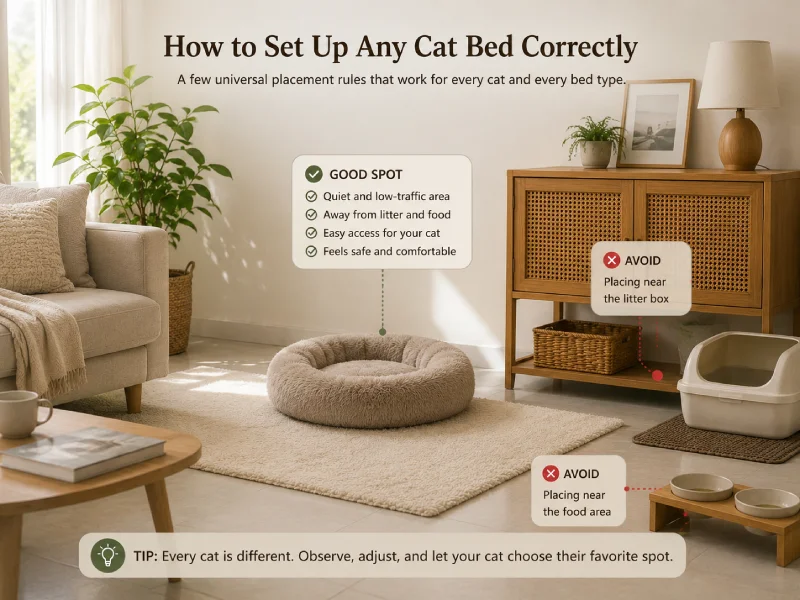
If your cat ignores the bed entirely in the first week, try relocating it before concluding that the type is wrong. Placement is often the issue, not the bed itself.
Which Cat Bed Should You Buy? A Quick Decision Guide
Choose the situation that sounds most like yours — not the bed with the most features.
Quick Decision Guide
If Your Cat Likes to Hide…
Enclosed or cave bed. Defined walls and a roof on all sides give cats that seek enclosure a designated secure spot — particularly useful for newly adopted cats still adjusting to a new environment.
If Your Cat Sleeps Stretched Out…
Open flat cushion. A comfortable surface without boundaries or enclosure — the most flexible placement option and the easiest type to keep clean. The right starting point for cats already showing relaxed, open sleeping behavior.
If Your Cat Likes to Feel Surrounded…
Bolster or donut bed. A raised rim around the perimeter gives cats a boundary to rest against without a roof overhead — the natural choice for cats that consistently lean against sofa arms, pillow edges, or any raised surface.
If Warmth Is the Priority…
Heated or self-warming bed. Choose self-warming if there’s no power outlet nearby or you’d rather avoid the added electricity cost. Choose electric heated if your home gets genuinely cold overnight and you have an outlet available in the intended location.
If Budget Comes First…
Basic flat cushion. Functional, low-maintenance, and a sensible starting point before investing in a more specialized type. Gives you time to observe your cat’s actual preferences before committing to an upgrade.
Ready to continue your setup? Return to the new cat checklist to work through the remaining supply categories before your cat arrives.