Some links on this page are affiliate links. If you purchase through them, FirstPawGuide may earn a commission at no additional cost to you. Recommendations are based on editorial evaluation and are not influenced by affiliate partnerships.
Best Scratching Post for Cats: Which Type Fits Your Cat and Home?
There’s no single best scratching post for every cat — the right type depends on how your cat naturally scratches and where the scratcher will fit in your home. This guide helps you choose based on your specific situation, not based on which post has the most features. Four main types are covered: tall vertical posts, horizontal scratchers, wall-mounted scratchers, and cat trees with integrated scratching surfaces. Getting the right type in place before your cat arrives is the most practical way to protect your furniture from day one.
For a broader overview of everything to set up before your cat arrives, the complete first-time cat owner guide covers scratching setup alongside every other essential decision.
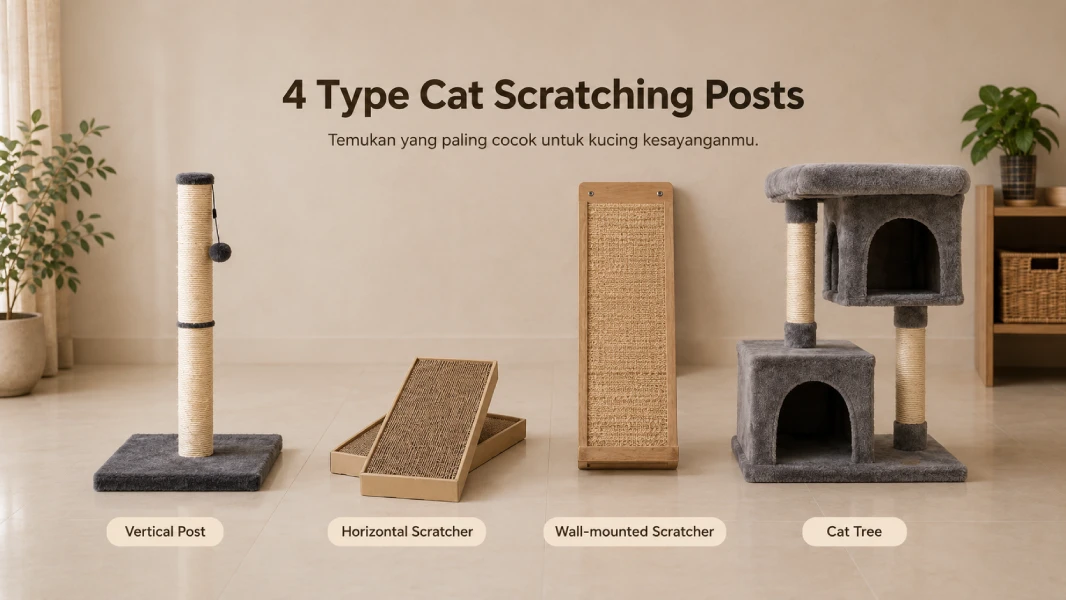
What This Guide Covers
- Four scratcher types — tall vertical post, horizontal scratcher, wall-mounted panel, and cat tree — each match a different scratching orientation, not a single “best” scratcher for every cat.
- Stability, height, and orientation match are the three attributes that determine whether your cat actually uses the scratcher you buy.
- The quick decision guide at the end matches your cat’s scratching behavior and your space to the right starting type, with room to add more later.
What Makes a Good Scratching Post for a First-Time Cat Owner?
Before getting into situation-specific recommendations, here are seven criteria worth considering. These aren’t product specifications — they’re decision attributes that will help you evaluate which type fits your cat and your home best.
- Height relative to your cat’s stretch — a vertical post should be tall enough for your cat to fully extend their body while scratching; a practical guideline is at least 28–32 inches for most adult cats
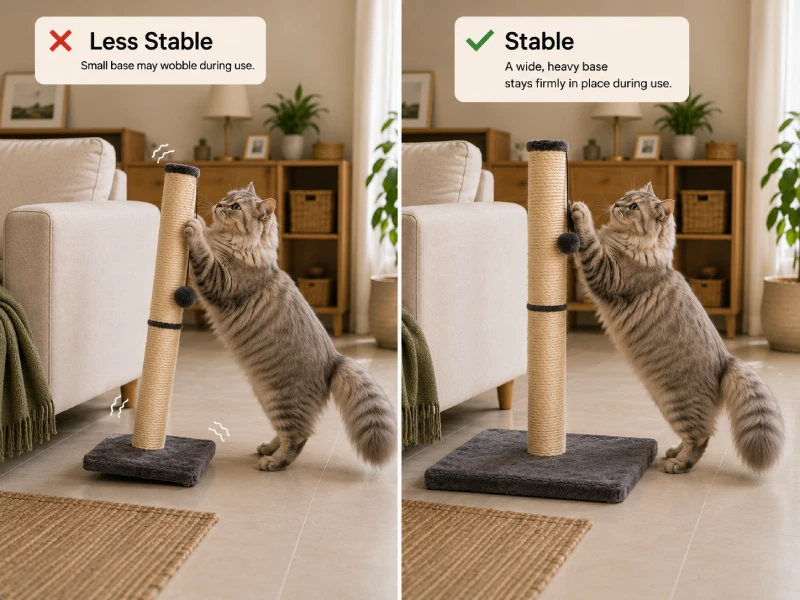
- Stability — the post must not wobble or tip when your cat applies full body weight; an unstable post will be abandoned within days and defeats its purpose entirely
- Scratching surface material — sisal rope and sisal fabric are the most durable and most widely accepted by cats; cardboard is effective but wears faster; carpet is less preferred by many cats and can blur the boundary between the scratcher and your household rugs
- Orientation match — observe whether your cat scratches vertical surfaces (furniture legs, door frames) or horizontal ones (rugs, carpet) before buying; most cats have a clear preference that tells you exactly which type to get
- Footprint and placement — the scratcher needs to fit the location you have in mind without blocking traffic flow or taking up more floor space than you can spare
- Durability relative to budget — a scratcher that wears out in two months costs more in the long run than a sturdier option bought once
- Your cat’s current scratching behavior — if your cat is already scratching a specific surface or location in your home, that tells you both their orientation preference and their preferred placement before you buy anything
Focus on stability, height, and orientation match first — these three determine whether your cat will actually use the scratcher you choose.
Best Scratching Post for Cats That Scratch Vertically and Stretch Up
Works well if
- Your cat consistently scratches vertical surfaces — furniture legs, door frames, sofa sides
- You want the most space-efficient vertical option
- You have a clear corner or wall area for stable placement next to existing furniture
Less suitable if
- You can’t verify the base weight before buying — a small, light base risks wobbling under full body weight
Cats that consistently scratch vertical surfaces — furniture legs, door frames, the sides of sofas — are giving you a clear signal about which scratcher type they’re most likely to actually use.
A tall standalone sisal post fits this situation best. It provides a vertical surface at the right height for a full-body stretch, in the material cats find most satisfying to scratch. The most effective way to use it: place it directly next to the furniture your cat is already targeting. Your cat has already chosen that location — give them an appropriate surface in the same spot, and redirection happens naturally without any additional management from you.
One trade-off to understand before choosing this type: a tall standalone post has a relatively small base for its height, and stability depends entirely on the weight and construction quality of that base. A post that wobbles the first time your cat applies full body weight will be abandoned immediately — and your cat will go back to the sofa. Check the base weight before buying, not just the height or the look of the surface.
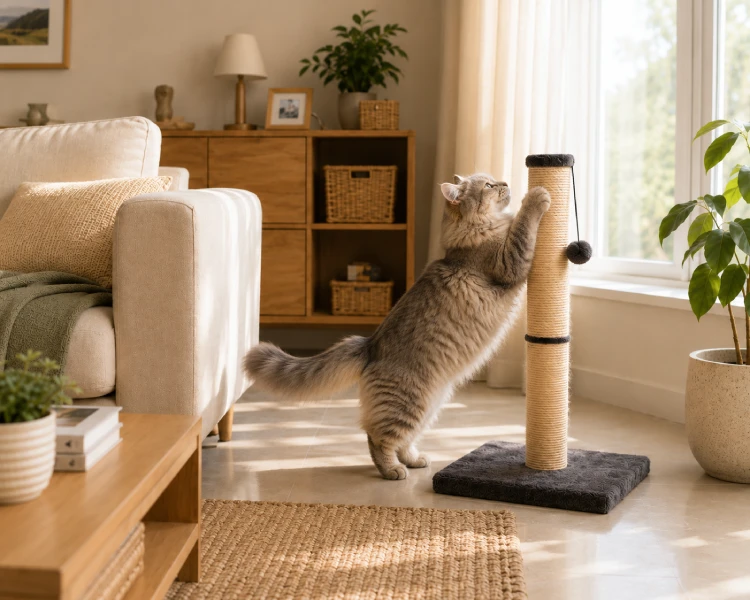
Sisal rope or sisal fabric is the most effective surface material for vertical posts — it provides the resistance cats seek when scratching and holds up significantly longer than carpet-covered posts at the same price point.
Choose this if:
- Your cat consistently scratches vertical surfaces — furniture legs, door frames, or the sides of sofas and chairs
- You want the most space-efficient vertical option with a minimal floor footprint
- Your home has a clear corner or wall area where a tall post can be placed stably next to existing furniture
- You’re setting up a scratching spot before your cat arrives and want to start with the most universally effective type
![[Product Name] — tall vertical sisal scratching post](/assets/images/products/[vertical-sisal-post-product-image].webp)
[Product Name]
Best for: Cats that already scratch vertical surfaces like furniture legs or door frames
[Reason — 1-2 sentences, decision-context framing]
Best Scratching Post for Cats That Prefer Scratching on the Floor
Works well if
- Your cat consistently scratches rugs, carpet, or flat floor surfaces
- You want a low-profile option with no risk of tipping
- Your cat has already shown interest in cardboard or flat textured surfaces
Less suitable if
- You want the lowest-maintenance option — cardboard wears out faster than sisal and sheds particles as it breaks down
Cats that regularly scratch rugs, carpet, or flat floor surfaces aren’t doing something wrong — they’re scratching in the orientation that comes naturally to them, and the right scratcher meets them there.
A horizontal scratcher — flat or angled — fits this situation best. It provides a scratching surface in the orientation your cat already prefers, without requiring any change in their natural behavior. An angled scratcher offers a middle ground — part flat, part inclined — which works well for cats that show interest in both orientations. This isn’t a lesser option than a vertical post; it’s the right option for a cat with a horizontal scratching preference, and putting a vertical post in front of a cat that prefers horizontal scratching solves nothing.
One honest trade-off: horizontal scratchers — particularly cardboard ones — wear out faster than sisal vertical posts and need more frequent replacement. Cardboard also sheds particles as it breaks down, which means more cleanup around the scratcher area. If you choose cardboard, budget for periodic replacement as part of your regular cat ownership routine.
Cardboard is the most common material for horizontal scratchers and works well — but flat sisal pads or angled sisal boards last longer and produce significantly less debris if you want a lower-maintenance option.
Choose this if:
- Your cat consistently scratches rugs, carpet, or flat floor surfaces rather than vertical furniture
- You want a low-profile option that sits flat on the floor with no risk of tipping or falling
- Your cat has already shown interest in scratching cardboard boxes or similar flat textured surfaces
- You want a secondary scratcher to complement a vertical post in a different room or area of your home
![[Product Name] — horizontal cardboard or sisal scratcher](/assets/images/products/[horizontal-scratcher-product-image].webp)
[Product Name]
Best for: Cats that scratch rugs, carpet, or flat surfaces rather than furniture
[Reason — 1-2 sentences, decision-context framing]
Best Scratching Post for Small Spaces and Minimal Footprint
Works well if
- You live in a studio or small apartment where floor space is a genuine constraint
- Your cat scratches vertically but a standalone post would block traffic flow
- You own your home or your rental agreement allows wall modifications
Less suitable if
- You’re renting without permission to drill or mount on the wall
- You’re not sure of your furniture arrangement — once installed, it can’t easily be relocated
If you’re in a studio or small apartment where every square foot is accounted for — and where a full-size vertical post would block traffic or take up space you don’t have — there’s an option that removes the trade-off between providing a good scratching surface and keeping your space functional.
A wall-mounted scratcher fits this situation best. By moving the scratching surface onto the wall, it eliminates the floor footprint entirely. A sisal panel or angled sisal pad mounted at the right height gives your cat a stable, effective vertical scratching surface with no base to tip, no floor space consumed, and no stability concerns. For cats that scratch vertically in small apartments, this is the most practical space management solution available.
The trade-off is a one-time commitment rather than an ongoing one: wall-mounted scratchers require drilling or strong adhesive mounting — not suitable for renters who can’t make wall modifications, or for walls where the correct mounting height can’t be achieved. Once installed, it can’t easily be relocated if your furniture arrangement changes.
Sisal fabric panels work best for wall mounting — they’re flat, lightweight, and provide the surface resistance cats prefer for vertical scratching without adding bulk to the wall.
Choose this if:
- You live in a studio or small apartment where floor space is a genuine constraint
- Your cat scratches vertically but a standalone post would block traffic flow or take up needed floor area
- You own your home or your rental agreement allows wall modifications
- You want a permanent, stable scratching surface that won’t shift, tip, or need to be repositioned
![[Product Name] — wall-mounted sisal scratching panel](/assets/images/products/[wall-mounted-scratcher-product-image].webp)
[Product Name]
Best for: Small apartments where floor footprint is the main constraint
[Reason — 1-2 sentences, decision-context framing]
Best Scratching Post If You Want One Setup That Does More
Works well if
- You want multiple scratching surfaces in one stable unit rather than several separate posts
- Your living space can accommodate a larger footprint
- Your budget allows for a higher upfront investment
Less suitable if
- You live in a very small space, or want to keep startup costs minimal — cat trees are the most expensive and largest-footprint option
If you want to provide multiple scratching surfaces at different heights in a single stable unit — rather than placing several separate posts around your home — there’s one type designed specifically for that.
A cat tree with integrated scratching surfaces fits this situation best. The sisal-wrapped posts and platforms in a cat tree give your cat multiple scratching surfaces in one footprint, at different heights, all built around a base substantial enough to stay stable under full scratching pressure. For cats that scratch vertically, this means more options within a single purchase — and a base that’s considerably more stable than a standalone post of the same height. Cat trees also give your cat elevated resting spots alongside the scratching surfaces, which many cats use regularly.
The trade-off is straightforward: cat trees take up significantly more floor space than any other scratcher type and are the most expensive option in this category — not practical for very small living spaces or for owners who want to keep startup costs minimal.
Choose this if:
- Your cat scratches vertically and you want multiple scratching surfaces in one stable unit rather than several separate posts
- Your living space can accommodate the larger footprint without constraining other furniture placement
- You want a single purchase that provides durable scratching surfaces at different heights
- Your budget allows for a higher upfront investment in a more substantial setup
![[Product Name] — cat tree with integrated sisal scratching surfaces](/assets/images/products/[cat-tree-product-image].webp)
[Product Name]
Best for: Owners who want multiple scratching surfaces and resting spots in one stable unit
[Reason — 1-2 sentences, decision-context framing]
Best Scratching Post If Budget Is a Primary Consideration
Works well if
- You’re managing multiple startup costs simultaneously
- You want to confirm your cat’s scratching orientation before investing in a larger type
- Your cat hasn’t yet shown a clear scratching preference
Less suitable if
- You don’t prioritize base stability — the most common budget scratcher failure is a post that wobbles under full weight
If you’re managing multiple startup purchases at once in the first month of cat ownership, choosing a functional scratcher without premium features is a practical and entirely reasonable decision.
A basic tall sisal post or a cardboard horizontal scratcher works reliably and is straightforward to maintain. No mechanism to malfunction, no components that need regular replacement beyond the scratching surface itself, and no special placement requirements. Starting with a basic option also gives you the opportunity to observe your cat’s actual scratching orientation before committing to a larger or more specialized type — and that observation is genuinely useful information for any future upgrade. Estimated cost: $15–$35 for a basic sisal post or cardboard horizontal scratcher, depending on brand and where you shop. Prices vary by region and retailer.
The trade-off worth knowing: budget scratchers vary significantly in base stability — the most common failure point is a post that wobbles under a cat’s full weight. Within a budget range, prioritize a heavier base over a taller post or a larger scratching surface. A basic sisal rope post will also outlast a carpet-covered post at the same price point — sisal holds up considerably better under daily use.
Choose this if:
- You’re managing multiple startup costs simultaneously in your first month of cat ownership
- You want to confirm your cat’s scratching orientation before investing in a larger or more specialized type
- Your cat hasn’t yet shown a clear scratching preference
- You plan to reassess your setup after the first few months of ownership
![[Product Name] — basic sisal post or cardboard scratcher](/assets/images/products/[budget-scratcher-product-image].webp)
[Product Name]
Best for: First-time owners managing multiple startup costs at once
[Reason — 1-2 sentences, decision-context framing]
How to Set Up Any Scratching Post Correctly
Even the right scratcher type won’t get used consistently if it’s placed in the wrong location or introduced the wrong way. These setup steps apply to every type covered in this article.
- Place near the furniture your cat is already targeting or is likely to target — proximity to the temptation is the most reliable way to redirect scratching to the right surface from the start
- Position in a location your cat already uses regularly — visible, accessible spots in higher-traffic areas work better than isolated corners for initial acceptance
- Secure or weight the base before your cat uses it for the first time — a post that wobbles on first contact teaches your cat to avoid it, not use it
- Introduce with a familiar scent or a small amount of catnip placed near the base to encourage initial interest — don’t force your cat onto the scratcher or physically place their paws on it
- Avoid moving the scratcher once your cat has started using it consistently — relocate only if it’s clearly being ignored after the first week
- Replace or refresh the scratching surface when it becomes visibly worn — a flattened or shredded surface loses the resistance cats need for effective scratching, and a worn-out scratcher stops doing its job
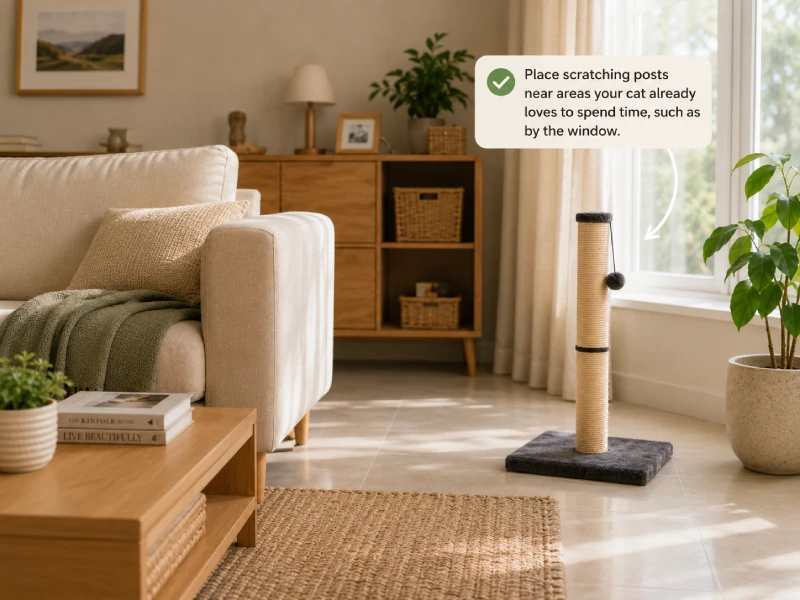
If your cat ignores the scratcher in the first week, try moving it closer to the furniture they’re targeting before concluding that the type is wrong. Location is usually the issue, not the scratcher itself.
Which Scratching Post Should You Buy? A Quick Decision Guide
Choose the situation that sounds most like yours — not the post with the most features.
Quick Decision Guide
If Your Cat Scratches Vertically…
Tall standalone sisal post. A full-height vertical surface in the most durable scratching material available. Place it directly next to the furniture your cat is already targeting for the fastest redirection.
If Your Cat Prefers the Floor…
Horizontal scratcher — flat or angled. Low-profile, no tipping risk, and the right orientation for cats that consistently scratch rugs or flat surfaces. Sisal fabric lasts longer than cardboard with less cleanup.
If Space Is the Main Constraint…
Wall-mounted sisal scratcher. Eliminates the floor footprint entirely — the most space-efficient vertical scratching solution for small apartments. Requires wall modification capability.
If You Want One Setup That Does More…
Cat tree with integrated scratching surfaces. Multiple sisal scratching surfaces at different heights in one stable unit. Requires more floor space and a higher upfront investment than standalone options.
If Budget Comes First…
Basic sisal post or cardboard horizontal scratcher. Functional, low-maintenance, and a sensible starting point before investing in a more specialized type. Prioritize base stability over height or surface area when choosing within a budget range.
Ready to continue your setup? Return to the new cat checklist to work through the remaining supply categories before your cat arrives.