Some links on this page are affiliate links. If you purchase through them, FirstPawGuide may earn a commission at no additional cost to you. Recommendations are based on editorial evaluation and are not influenced by affiliate partnerships.
Best Cat Litter Box for First-Time Owners: Which Type Fits Your Home and Cat?
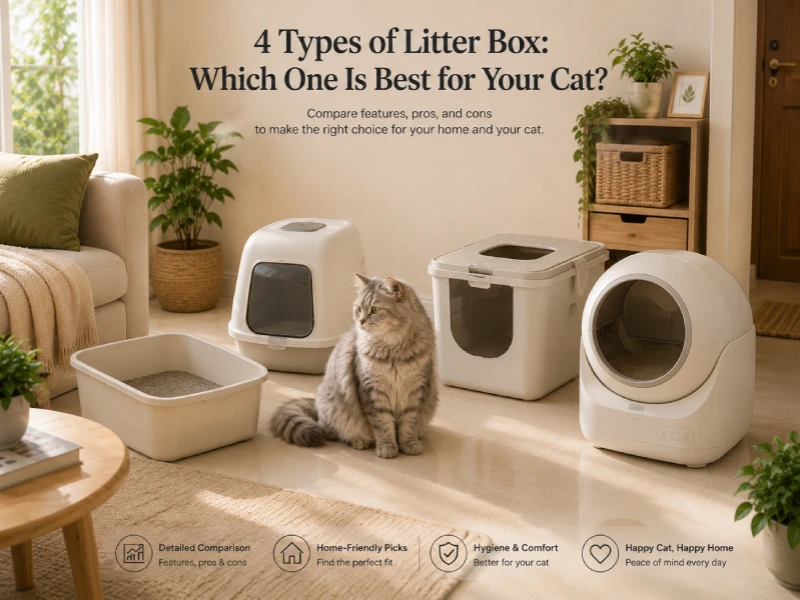
There’s no single best litter box for every situation — the right choice depends on your living space, your daily routine, and your cat’s preferences. This guide helps you choose based on your specific situation, not based on which product has the most features. Four main types are covered: open, covered, top-entry, and self-cleaning. Each one fits a different set of circumstances.
For a broader overview of everything to set up before your cat arrives, the complete first-time cat owner guide covers litter box selection alongside every other essential decision.
What This Guide Covers
- Four litter box types — open, covered, top-entry, and self-cleaning — each fit a different living situation, not a single “best” option for everyone.
- Space, maintenance tolerance, your cat’s temperament, odor control needs, and budget are the real decision attributes — not product features.
- The quick decision guide at the end matches your specific situation to the right starting type, with room to upgrade later.
What Makes a Good Litter Box for a First-Time Cat Owner?
Before getting into situation-specific recommendations, here are seven criteria worth considering. These aren’t product specifications — they’re decision attributes that will help you evaluate which type fits your circumstances best.
- Size relative to your cat — the box should be large enough for your cat to turn around and dig comfortably. A practical guideline: approximately 1.5 times your cat’s length from nose to tail base.
- Entry type — front-entry, top-entry, or hooded. Entry type affects how easily your cat gets in and out, which matters more for kittens, older cats, or cats that prefer enclosed spaces.
- Ease of scooping and cleaning — some designs make daily scooping significantly easier than others. You’ll be doing this every day, so it’s worth factoring in from the start.
- Level of odor containment needed — depends on where the litter box will be placed and how sensitive the people in your household are to pet odors.
- Available space for placement — the box’s footprint needs to fit the location you have in mind without blocking traffic flow in the room.
- Budget range — a litter box is a one-time purchase that can last years. Spending a little more upfront can avoid multiple replacements.
- How easy it is to use every day — the best choice isn’t the one with the most features; it’s the one you can realistically maintain as part of a daily routine. You don’t need to maximize every criterion at once. Focus on the attributes that matter most for your living situation and schedule.
Best Litter Box for Small Apartments and Limited Spaces
Works well if
- You live in a studio or one-bedroom apartment with limited floor space
- Litter tracking onto floors is a problem you want to minimize
- Your cat is healthy and mobile enough to jump comfortably
Less suitable if
- Your cat is a very young kitten
- Your cat has mobility limitations that make jumping up onto the lid difficult
If you live in a studio or one-bedroom apartment with limited floor space — where the litter box will be visible to guests or where every square foot matters — the standard open or covered box often takes up more room than it needs to.
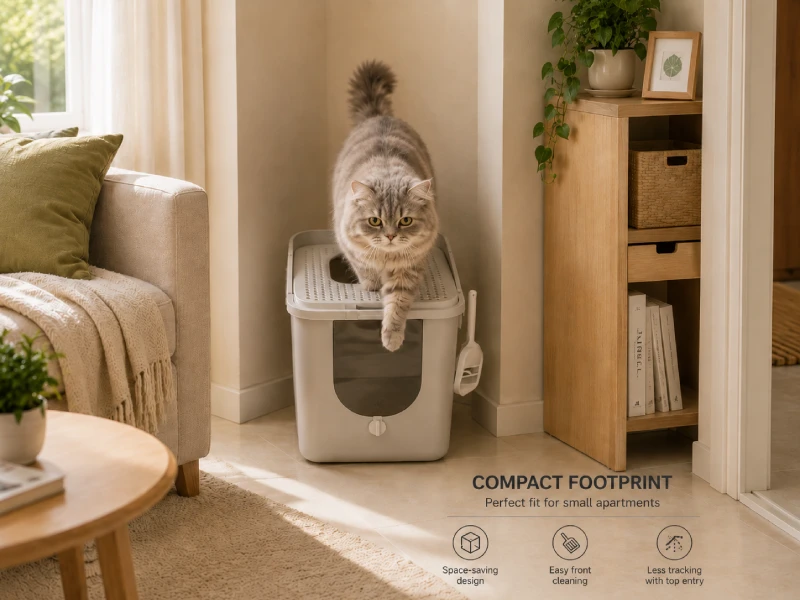
A top-entry litter box fits this situation best. Because your cat enters from above rather than the side, the footprint is significantly smaller than a side-entry box of equivalent internal capacity. That means you can place it in a tighter corner without sacrificing usable space inside.
Top-entry boxes also naturally reduce litter tracking. Litter clinging to your cat’s paws falls back into the box as they jump out rather than scattering across your floor — a meaningful advantage in a small space where floor mess is more visible and harder to contain.
One honest trade-off: top-entry boxes require your cat to jump up onto the lid, which makes them less suitable for very young kittens or cats with mobility limitations. For a healthy adult cat, this is rarely an issue.
Choose this if:
- You live in a studio or one-bedroom apartment
- Litter tracking onto floors is a problem you want to minimize
- You want natural odor containment without a separate cover component
- Your cat is healthy and mobile enough to jump comfortably
![[Product Name] — top-entry litter box](/assets/images/products/[top-entry-litter-box-product-image].webp)
[Product Name]
Best for: Small apartments where floor space and litter tracking are the main concerns
[Reason — 1-2 sentences, decision-context framing]
Best Litter Box for First-Time Owners Who Want Low Maintenance
Works well if
- You work long hours or travel away from home regularly
- Daily manual scooping feels like a genuine barrier to maintaining routine
- Your budget allows for a higher upfront investment
Less suitable if
- Your cat is easily startled by mechanical components or motor sounds
- Your budget is tight, since prices commonly run $50 to over $500
- You’d rather avoid the long-term risk of mechanical parts failing
If you work long hours, travel regularly, or simply want to reduce the number of daily tasks that come with cat ownership, a self-cleaning (automatic) litter box is designed specifically for this situation.
Self-cleaning boxes use a mechanical rake or rotating mechanism to move clumps into a sealed waste compartment automatically after your cat uses the box. In practice, this means emptying the waste drawer every few days rather than scooping every day. You will still need to monitor litter levels and perform regular full cleaning — self-cleaning does not mean maintenance-free.
A self-cleaning litter box costs significantly more upfront than any other type — common price ranges run from $50 to over $500 depending on the model. Beyond cost, there are two other trade-offs to factor in before buying: some cats refuse to use boxes with mechanical components or motor sounds, particularly cats that are new to a home; and mechanical parts can fail over time, adding potential repair or replacement costs to the long-term equation.
Choose this if:
- You work long hours or travel away from home regularly
- Daily manual scooping feels like a genuine barrier to maintaining routine
- Your budget allows for a higher upfront investment
- Your cat is comfortable with new equipment and not easily startled by mechanical sounds
![[Product Name] — self-cleaning litter box](/assets/images/products/[self-cleaning-litter-box-product-image].webp)
[Product Name]
Best for: Owners with busy schedules who want to reduce daily scooping
[Reason — 1-2 sentences, decision-context framing]
Best Litter Box If Your Cat Is Shy or Easily Startled
Works well if
- Your cat generally prefers enclosed spaces — hides in boxes, uses cat caves, chooses sheltered resting spots
- The litter box will be placed in a higher-traffic area of your home
Less suitable if
- You can’t commit to scooping at least once daily — odor traps inside the hood faster than in an open box
Some cats — particularly those newly adopted or coming from quieter environments — are more comfortable using a litter box that offers a degree of enclosure and separation from household activity.
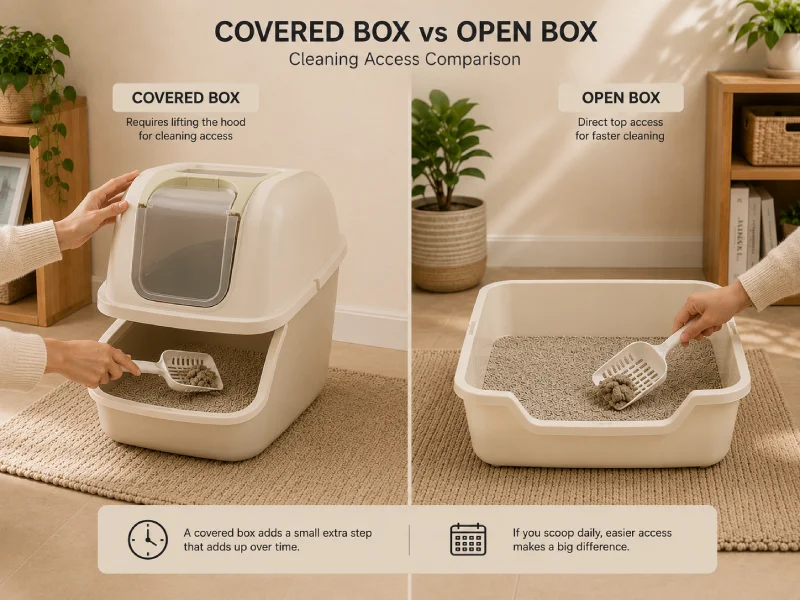
A covered (hooded) litter box with a front entry gives cats that prefer privacy a more defined, enclosed space to use without feeling exposed. The hood and side walls create a boundary that reduces visual disturbance from movement nearby, which can make a real difference during the adjustment period.
A covered litter box traps odors inside the hood if it isn’t cleaned frequently — this is the most important trade-off to understand before choosing this type. Many first-time owners assume the cover means less cleaning is needed. The opposite is true: a covered box requires more frequent scooping than an open box, not less. If you can’t commit to scooping at least once daily, the odor buildup inside a covered box will discourage your cat from using it.
Choose this if:
- Your cat generally prefers enclosed spaces — hides in boxes, uses cat caves, chooses sheltered resting spots
- The litter box will be placed in a higher-traffic area of your home
- You can commit to scooping at least once daily to prevent odor from building up inside the hood
![[Product Name] — covered litter box](/assets/images/products/[covered-litter-box-product-image].webp)
[Product Name]
Best for: Shy cats that prefer an enclosed, private space
[Reason — 1-2 sentences, decision-context framing]
Best Litter Box for Odor Control in Shared Living Spaces
Works well if
- Odor is your primary concern rather than aesthetics or footprint
- You live with people who are sensitive to pet smells
- You can commit to scooping at least once daily as a non-negotiable routine
Less suitable if
- You can’t commit to daily scooping — no filter or hood substitutes for cleaning frequency
If you live with roommates, a partner, or family members who don’t own cats — or if placement options mean the litter box needs to be near living areas — odor management becomes the primary decision driver.
Two solutions work equally well here, and both are worth considering. A large open box with high sides and a carbon filter insert provides enough ventilation to prevent odor buildup while the high walls contain litter scatter. Carbon filters can help reduce odor, but consistent daily cleaning remains the most important factor — the filter supplements routine, it doesn’t replace it. Alternatively, a covered box cleaned twice daily can achieve the same result with better visual concealment, but only if the cleaning schedule is genuinely maintained.
Both options require scooping at least once daily. No litter box type can substitute for adequate cleaning frequency — particularly in shared living situations where cleanliness standards affect more than one person.
Choose this if:
- Odor is your primary concern rather than aesthetics or footprint
- You live with people who are sensitive to pet smells
- You can commit to scooping at least once daily as a non-negotiable routine
- Placement options are limited to shared living areas
![[Product Name] — open litter box with carbon filter](/assets/images/products/[odor-control-litter-box-product-image].webp)
[Product Name]
Best for: Shared living spaces where odor sensitivity is a household concern
[Reason — 1-2 sentences, decision-context framing]
Best Litter Box If Budget Is a Primary Consideration
Works well if
- You’re managing multiple startup costs simultaneously
- You want to build solid litter maintenance habits before upgrading to automated options
- Your cat hasn’t shown strong preferences around privacy or entry type yet
Less suitable if
- You’re not able to scoop more frequently — an open box without odor-containment features needs more frequent attention
If you’re managing multiple startup purchases at once in the first month of cat ownership, choosing a functional litter box without premium features is a practical and entirely reasonable decision.
A basic open litter box — no hood, no mechanism, no special features — works reliably and is straightforward to maintain. Your cat can enter from any direction, scooping doesn’t require removing or replacing components, and there are no mechanical parts that can fail. This is the type used by the majority of cat owners globally, and it works well when cleaned consistently.
An open box without odor-containment features requires more frequent scooping than covered or self-cleaning alternatives — that’s the honest trade-off. But for a first-time cat owner still building their litter maintenance routine, starting with a basic open box builds the core habits correctly before investing in automated or specialized options.
Choose this if:
- You’re managing multiple startup costs simultaneously
- You want to build solid litter maintenance habits before upgrading to automated options
- Your cat hasn’t shown strong preferences around privacy or entry type yet
- You plan to reassess your setup after the first few months of ownership
![[Product Name] — basic open litter box](/assets/images/products/[basic-open-litter-box-product-image].webp)
[Product Name]
Best for: First-time owners managing multiple startup costs at once
[Reason — 1-2 sentences, decision-context framing]
How to Set Up Any Litter Box Correctly
Even the best litter box won’t work well if it’s placed in the wrong location or maintained inconsistently. These setup rules apply to every type covered in this article.
- Place in a quiet, low-traffic area — away from your cat’s food and water
- Fill to 3 to 4 inches (7–10 cm) of litter depth — too shallow makes digging uncomfortable
- Position with at least two open sides rather than pushed directly into a corner — your cat should be able to approach from more than one direction
- Plan for one litter box per cat plus one extra — for one cat, that means two boxes ideally. If space is limited, prioritize a consistent location over forcing an ideal placement that’s hard to maintain
- Scoop at least once daily without exception
- Full clean and litter replacement every one to two weeks, depending on litter type
Once you have chosen the location, avoid moving the litter box unless there is a clear reason to do so — consistency of placement helps your cat orient reliably from the start.
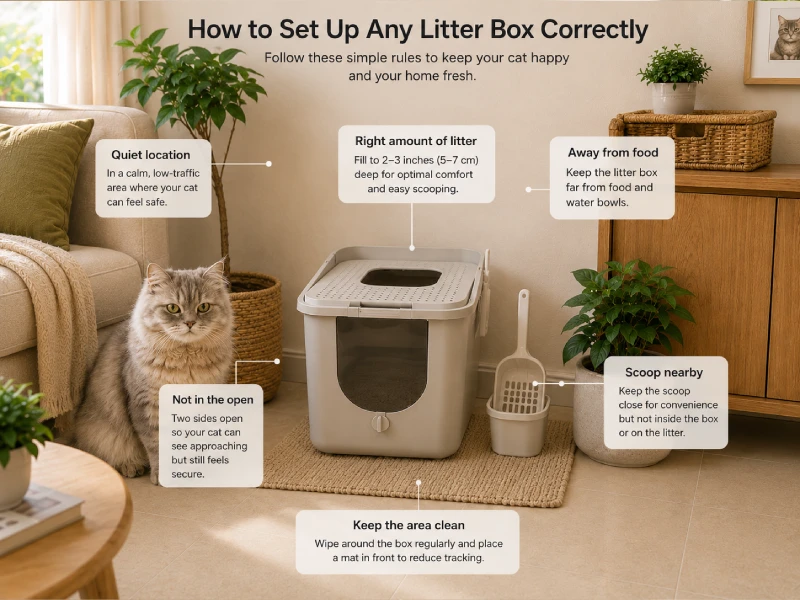
For a complete list of everything to set up before your cat arrives, the new cat checklist covers litter box setup alongside every other essential supply.
Which Litter Box Should You Buy? A Quick Decision Guide
If you’ve read this far, your situation is clear enough to make a decision. Choose the situation that sounds most like yours rather than trying to find a universally ‘best’ litter box.
Quick Decision Guide
If You’re in a Small Space…
Top-entry litter box. Small footprint, minimal tracking, natural odor containment. Works best for healthy adult cats that can jump comfortably.
If Low Maintenance Is the Priority…
Self-cleaning litter box. Higher upfront cost and requires cat acceptance, but reduces manual scooping to emptying a waste drawer every few days.
If Your Cat Needs Privacy…
Covered hooded litter box. Provides an enclosed space for cats that prefer separation — but requires more frequent cleaning than open boxes to prevent odor from trapping inside.
If Odor Is the Main Concern…
Large open box with high sides and a carbon filter, or a covered box cleaned twice daily. Both work — choose based on your honest assessment of your cleaning routine.
If Budget Comes First…
Basic open litter box. Functional, reliable, easy to maintain. The right starting point before considering an upgrade.
No choice locks you in permanently. Once you’ve observed your cat’s habits over the first few months, you’ll have a much clearer picture of whether the litter box type you started with is still the right fit — and upgrading later is always an option.