Some links on this page are affiliate links. If you purchase through them, FirstPawGuide may earn a commission at no additional cost to you. Recommendations are based on editorial evaluation and are not influenced by affiliate partnerships.
Clumping vs Non-Clumping Cat Litter: Which Should You Choose as a First-Time Owner?
Once you’ve chosen your litter box type, litter type is the next decision — and it follows the same logic: there’s no universally better option, only the one that fits your daily routine and living setup. This guide helps you choose based on your specific situation, not based on claims about which option is cleaner or more convenient in general. By the end, you’ll have one clear decision: clumping or non-clumping.
For a broader overview of everything to set up before your cat arrives, the complete first-time cat owner guide covers litter selection alongside every other essential decision.
What This Guide Covers
- Clumping and non-clumping litter both work well — the right choice depends on your scooping preference, box type, budget, and household situation, not on which is “cleaner.”
- Box compatibility matters: top-entry and self-cleaning boxes require clumping litter, while non-clumping works with open and covered boxes.
- The situation-based guide at the end matches your routine and box type to the right starting litter, with room to switch later.
What’s the Actual Difference Between Clumping and Non-Clumping Cat Litter?
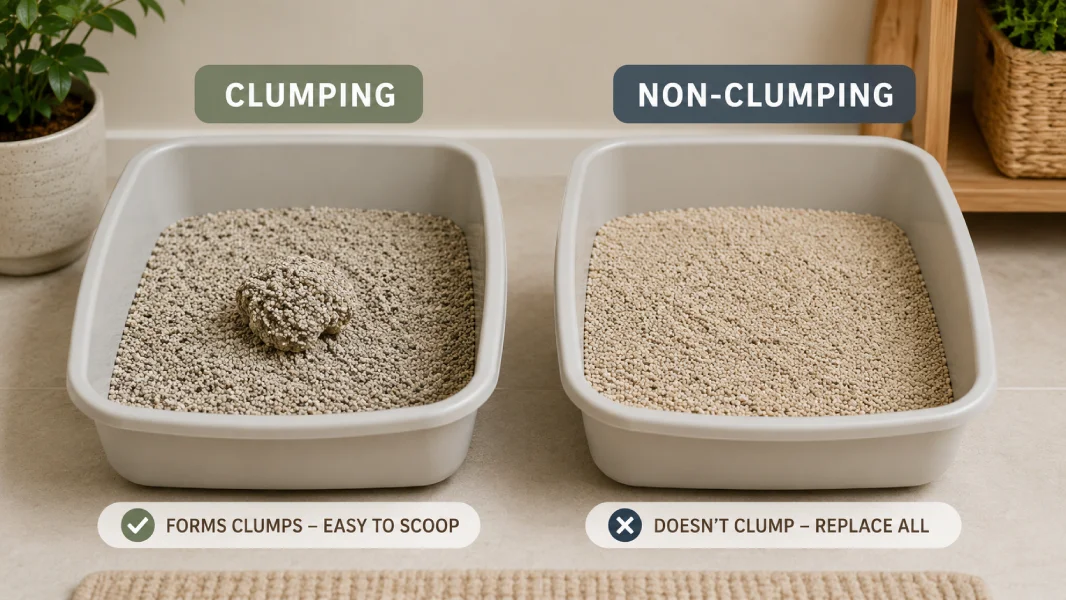
Before comparing by situation, it helps to understand the core attributes of each option. The table below is the shared reference for every section that follows — each later section interprets these differences for one specific decision attribute rather than repeating them.
| Attribute | Clumping | Non-Clumping |
|---|---|---|
| Waste removal | Scoop clumps daily | Full replacement |
| Change frequency | Top up daily + full change every 2–4 weeks | Full replacement every 1–2 weeks |
| Dust level | Low–medium | Low–high (varies by product) |
| Tracking potential | Medium | Low–medium |
| Odor control | Good with daily scooping | Depends on replacement frequency |
| Cost per use | Lower (only waste removed) | Higher (more frequent full replacement) |
| Box compatibility | Most types including top-entry and self-cleaning | Open and covered (not top-entry or self-cleaning) |
These are general characteristics rather than fixed rules. Individual products may differ.
The differences in this table aren’t about which option is better overall — they’re about which attributes matter most for your life as a first-time cat owner. Every section below interprets one of these attributes in terms of a specific decision.
Daily Maintenance and Scooping Ease: Which Fits Your Routine?
The first question to answer honestly: how do you prefer to manage the litter box — a little every day, or all at once on a schedule?
Clumping fits better when you’re comfortable with a brief daily scooping routine. Clumping litter forms solid clumps when it contacts urine, which means you remove only the soiled portion without replacing the entire contents. In practice: scoop for one to two minutes each day, add a small amount of fresh litter to maintain depth, and do a full replacement only every two to four weeks. This rhythm is consistent and predictable — many cat owners find it easier to integrate into a daily schedule than a larger periodic task.
Non-clumping fits better when you’d rather skip daily scooping entirely and handle the litter box in one go on a set schedule. Non-clumping litter absorbs urine without forming scoopable clumps — which means there’s nothing to scoop out effectively between changes. The approach that works for this type: leave it for several days, then do a full replacement every one to two weeks. One larger task in place of no small daily task.
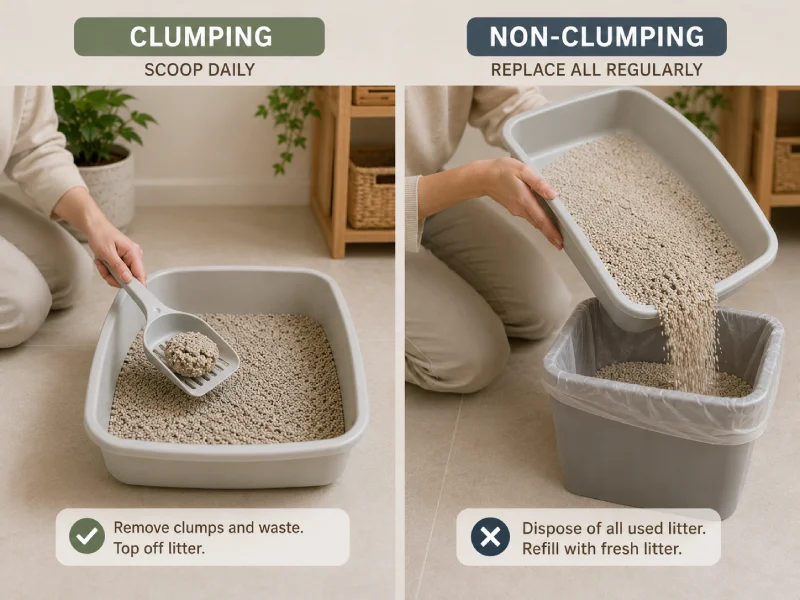
For first-time cat owners, the question isn’t which approach is objectively easier — it’s which rhythm you can realistically maintain. A brief daily scoop versus a full weekly change are both valid approaches, and the right one depends entirely on your existing daily routine.
Odor Control: Which Manages Smell Better in Practice?
Odor is one of the attributes that most directly affects the decision — particularly for owners in shared living spaces or smaller apartments.
Clumping manages odor through daily removal. Because urine clumps can be scooped out immediately, the primary source of odor is physically removed from the box each day. As long as scooping stays consistent, ammonia doesn’t accumulate. The effectiveness depends directly on your routine — clumping litter left unscooped for two days will smell worse than well-maintained non-clumping litter.
Non-clumping manages odor through replacement frequency and additives. Because urine is absorbed but not removed daily, non-clumping products often contain baking soda, activated carbon, or other deodorizing agents to neutralize odor between changes. Effectiveness depends on how frequently you replace the full contents — and on the quality of the product you choose.
For owners living with roommates, a partner, or family members who are sensitive to pet smells, clumping with daily scooping tends to offer more consistent odor management because the source is actively removed rather than neutralized. Non-clumping can be equally effective if the replacement schedule is genuinely maintained — but it leaves less margin for delay.
Cost and Longevity: Which Is More Affordable Over Time?
Cost is one of the most direct decision attributes for first-time cat owners, especially in the first months when multiple startup purchases happen at once.
Clumping is more cost-efficient per use because you remove only the soiled portion rather than the entire box contents. One bag of clumping litter lasts longer than a same-size bag of non-clumping litter under typical use, because weekly consumption is lower. Estimated monthly cost: $15–$30 per cat, depending on brand and where you shop.
Non-clumping is cheaper per bag but requires more frequent full replacements — which means total monthly cost can be comparable to or slightly higher than clumping, depending on your replacement frequency. Estimated monthly cost: $10–$25 per cat. The difference isn’t large, but it’s worth factoring in if budget is a primary consideration.
One practical note: these are general estimates and vary by brand, cat size, and number of cats. The most accurate way to evaluate actual cost is to compare price per pound or kilogram at your preferred store — not price per bag. Estimates vary by brand, region, and where you shop.
Tracking and Dust: What to Expect with Each Option
Tracking — litter carried out of the box on your cat’s paws — and dust are two factors that directly affect the cleanliness of your litter area, particularly in smaller spaces.
Clumping litter has medium tracking potential. Clumping granules — especially those made from sodium bentonite clay — are heavy enough that they don’t travel far, but they do stick to paw pads and can scatter across the floor around the box. If you’re using a top-entry litter box (recommended for small apartments in the best cat litter box guide), tracking is naturally reduced because litter clinging to your cat’s paws falls back into the box as they jump out. Dust levels vary by product — look for a “low-dust” label if dust is a primary concern.
Non-clumping varies more widely depending on formulation. Paper- or wood-based non-clumping litters tend to have very low tracking because of their larger granule size. Silica or mineral-based formulations are finer and can produce more dust. If you choose non-clumping, check the base material — not just the label — to predict tracking and dust behavior more accurately.
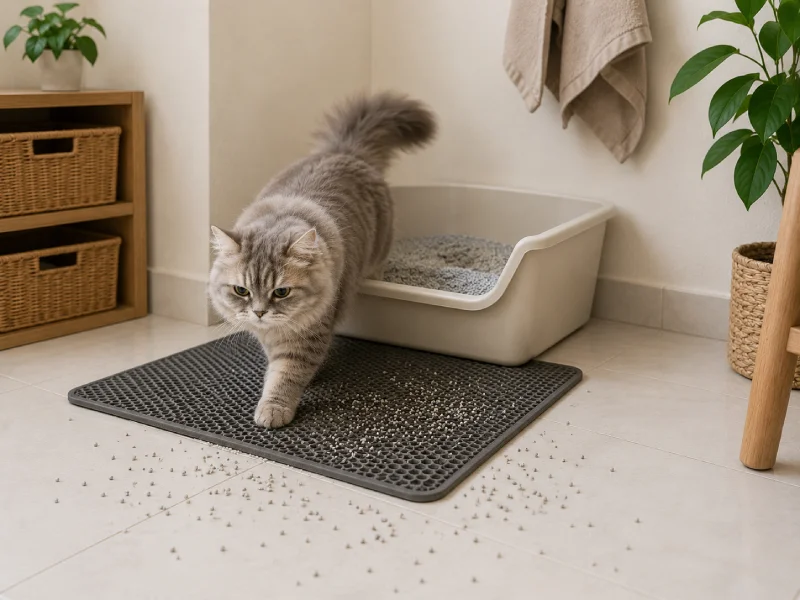
For owners in small apartments or shared living spaces, tracking and dust are more visible and harder to manage. A litter mat placed in front of the box reduces tracking meaningfully for either type. The box type you’re using also affects how much tracking occurs — choosing compatible box and litter types is the most effective way to minimize the issue.
Which Should You Choose? A Situation-Based Guide for First-Time Cat Owners
If you’ve read this far, you don’t need more information — you need to choose.
Quick Decision Guide
Works well if
- You’re comfortable with a brief daily scooping routine
- You use a top-entry or self-cleaning litter box
- Keeping monthly litter costs lower is a priority
Less suitable if
- You can’t commit to daily scooping — odor builds up faster than with non-clumping
- You have a very young kitten under three to four months
Choose Clumping Litter If…
Choose this if:
- You prefer a brief daily scooping routine over a periodic full litter change
- You use a top-entry or self-cleaning litter box — clumping is required for both of these types
- Keeping monthly litter costs lower over time is a priority
- You share your living space and want odor managed through active daily removal rather than a replacement schedule
![[Product Name] — clumping cat litter](/assets/images/products/[clumping-litter-product-image].webp)
[Product Name]
Best for: Owners with a top-entry or self-cleaning box who prefer brief daily scooping
[Reason — 1-2 sentences, decision-context framing]
Works well if
- You prefer one full change per week or every two weeks over daily scooping
- You use an open or covered box
- Your cat is very young — non-clumping is the safer starting option for kittens under three to four months
Less suitable if
- You use a top-entry or self-cleaning box — these require clumping litter
- You want the most consistent odor control without depending on a strict replacement schedule
Choose Non-Clumping Litter If…
Choose this if:
- You prefer one full litter change per week or every two weeks over daily scooping
- You use an open or covered box and daily scooping doesn’t fit your schedule
- Your cat is very young — check with your vet if you’re unsure
- You want to keep your initial setup as simple and low-commitment as possible before considering other options
![[Product Name] — non-clumping cat litter](/assets/images/products/[non-clumping-litter-product-image].webp)
[Product Name]
Best for: Owners with an open or covered box who’d rather do one full change a week
[Reason — 1-2 sentences, decision-context framing]
What About Natural or Crystal Litter?
Natural litter — made from plant-based materials like wood, corn, or recycled paper — and crystal litter (silica gel) exist as alternatives, but both involve more variables than clumping or non-clumping for a first setup: higher price points, more limited availability in many areas, and a steeper learning curve for both owner and cat. Both are worth exploring once you have a stable litter routine and a clearer picture of your individual cat’s preferences. For most first-time cat owners, simplifying this first decision tends to produce a routine that’s easier to maintain consistently.
Ready to continue your setup? Return to the new cat checklist to work through the remaining supply categories before your cat arrives.