How to Cat-Proof Your Apartment: A Room-by-Room Guide for First-Time Owners
Cat-proofing your apartment doesn’t require major changes — it requires finding and addressing the specific hazards that are most dangerous for a cat in a typical home. Most modifications can be completed in a single day before your cat arrives, and the result is a space where your cat can explore without requiring constant supervision. For the broader preparation checklist covering supplies and room setup, how to prepare your home for a new cat covers that territory.
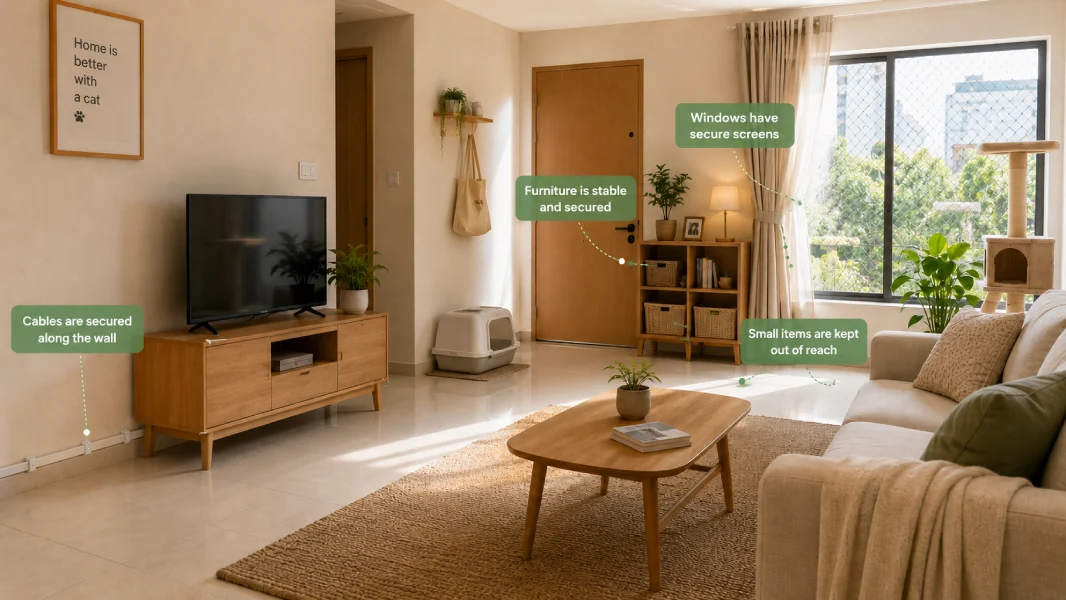
What This Guide Covers
- Cat-proofing is environment modification, not cat training — it works regardless of what your cat decides to do, and most of it can be completed in a single day.
- Five rooms and hazard categories are covered: kitchen, living room, windows and balconies, electrical cords and small objects, and toxic plants and chemicals.
- Windows and balconies carry the most serious consequences in this guide and should be addressed before your cat arrives — this category doesn’t offer a second chance.
What Cat-Proofing Actually Involves (And What It Doesn’t)
Cat-proofing is environment modification — not cat training. The distinction matters: environment modification works regardless of what your cat decides to do, while relying on your cat to avoid hazards is an unreliable strategy — particularly in the first weeks when you’re still learning each other.
Three things cat-proofing involves: identifying and removing or securing physical hazards; blocking access to spaces your cat shouldn’t reach unsupervised; and creating a clear, consistent environment before day one. Two things it doesn’t involve: permanently renovating your apartment, and training your cat to avoid hazards. Environment does that work — not the cat.
The goal is a space where your cat can explore without you needing to intervene constantly. Environment modification does that work upfront so supervision becomes the backup, not the primary strategy.
Kitchen and Food Storage
The kitchen has one of the highest concentrations of hazards in any apartment — not because it’s inherently dangerous, but because it combines access to food, cleaning products, hot surfaces, and waste in a single room.
Hazards to identify:
- Unsecured lower cabinet doors (cleaning products, food storage)
- Open or easily accessed trash bins (food waste, packaging)
- Hot stove surfaces during and after cooking
- Food left on countertops
- Small appliance cords (toasters, kettles) that dangle or trail
Prevention actions:
- Install childproof or magnetic cabinet locks on lower cabinets containing cleaning products or food
- Use a trash bin with a weighted, lockable, or pressure-sealed lid that requires deliberate effort to open
- Keep your cat out of the kitchen during cooking — establish a consistent boundary from day one rather than managing it situationally
- Clear countertops of food after every meal; don’t leave food accessible overnight
- Secure or bundle small appliance cords along the wall or counter edge
Verify: Are all lower cabinets closable without gaps? Is the trash bin inaccessible without deliberate effort? Is the stove area clear of objects that could fall onto a hot surface?
Living Room and Common Areas
The living room is the area most often assumed to be safe by first-time cat owners — and the area most likely to contain hidden hazards that don’t become visible until a cat is already inside exploring them.
Hazards to identify:
- Gaps behind and under large furniture (sofas, bookshelves — cats enter and get trapped)
- Unstable or top-heavy furniture (tall bookshelves, floor lamps — tipping risk under a cat’s weight or movement)
- Looped curtain or blind cords (entanglement hazard)
- Small objects on surfaces (coins, rubber bands, twist ties, hair ties — ingestion risk)
- Unsealed fireplace or unvented heater access (if applicable)
Prevention actions:
- Block gaps behind heavy furniture with cardboard, foam, or furniture repositioning — cats explore and then get stuck, not the reverse
- Anchor tall bookshelves and unstable furniture to the wall using furniture straps
- Replace looped curtain or blind cords with cordless alternatives, or secure all loops above the height your cat can reach
- Clear all flat surfaces of small objects before your cat arrives — rubber bands, hair ties, twist ties, coins, anything that fits in a closed fist
- Block access to any unsealed fireplace or unvented heater with a physical barrier
Verify: Are all gaps behind furniture blocked or inaccessible? Are tall items anchored to the wall? Are all looped cords replaced or secured above reach?
Windows, Balconies, and High-Risk Openings
This is the category with the most serious consequences in this guide. Unlike other hazards that can be addressed after they’re identified, this category doesn’t offer a second chance. Address it before your cat arrives, not after.
Window and balcony hazards carry the most serious consequences of any category in this guide — address them before your cat arrives, since this category typically doesn’t offer a second chance.
Hazards to identify:
- Open windows without screens (fall risk, especially above ground floor)
- Standard window screens that push out under pressure (standard screens are not designed to hold a cat’s weight or sustained pushing force)
- Open or unsecured balcony access
- Window gaps wide enough for a cat to squeeze through
Prevention actions:
- Install reinforced window screens — heavy-gauge mesh or metal mesh — on any window you open regularly
- Test every existing screen by pressing firmly from the inside with your palm; if it shifts or bows, it will not hold a cat
- Use window stoppers or locks to limit how far windows can open — less than four inches prevents most adult cats from squeezing through
- Block balcony access entirely or install cat netting around the full balcony perimeter before your cat arrives
- Keep windows closed or confirmed-screened during the initial settling period — at minimum the first two weeks
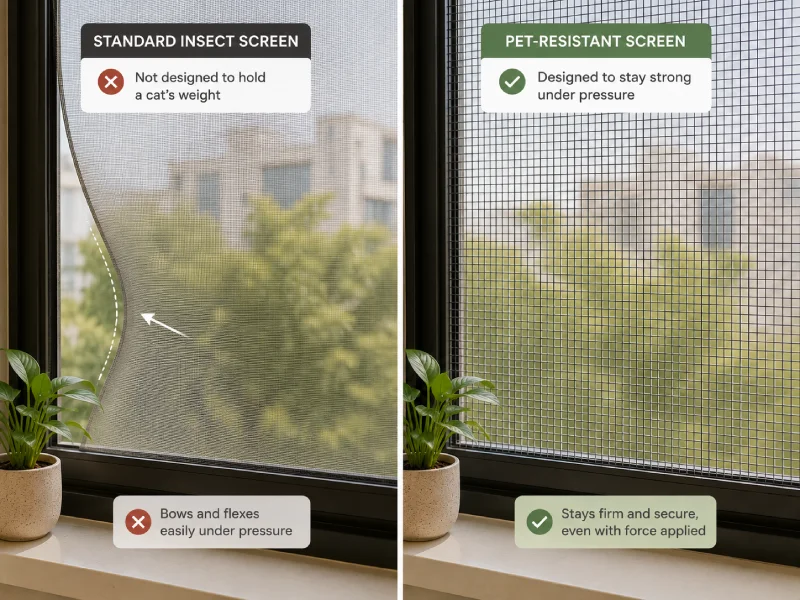
Verify: Are all regularly opened windows screened with reinforced mesh? Do screens hold firm under direct pressure? Is balcony access blocked or fully netted?
Electrical Cords and Small Objects
Electrical cords and small objects are two distinct hazard types that share the same locations — floors and low surfaces within easy reach.
Hazards to identify:
- Exposed electrical cords (chewing risk — higher for kittens, present for all cats)
- Loose cords that dangle or move (movement attracts attention and increases engagement)
- Small objects that can be swallowed (hair ties, rubber bands, string, twist ties, small toy components)
- Charging cables left plugged in at floor level or on low surfaces
Prevention actions:
- Route all cords along walls using cable clips or adhesive cord channels — eliminate any cord runs at floor level entirely
- Use split-loom cord covers or spiral wrap on any cord that can’t be fully hidden or routed against a surface
- Unplug and store charging cables when not in use — don’t leave cables plugged in at floor level or accessible on low surfaces
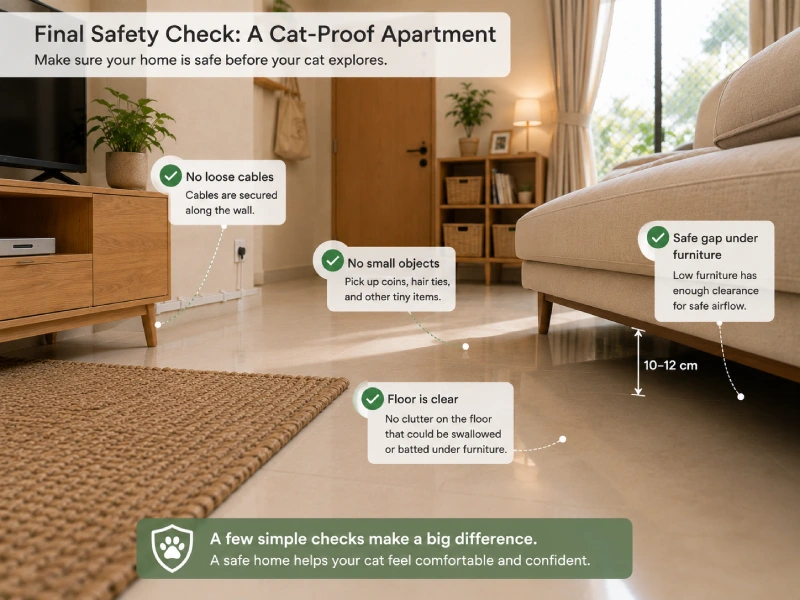
- Remove all small objects from floor level and low surfaces before your cat arrives — do a final check from cat height (crouch down and look)
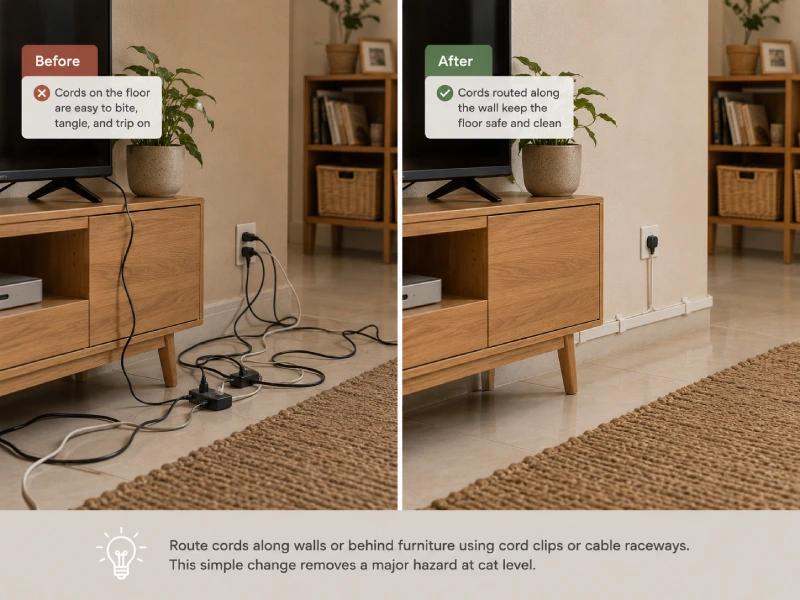
Verify: Are all cords at cat-accessible height either covered, bundled against the wall, or removed? Is the floor clear of any object small enough to be swallowed?
Toxic Plants and Household Chemicals
This category requires one step that can’t be deferred: verify every plant in your apartment before your cat arrives. Not all common houseplants are harmful to cats — but several that appear in many apartments are, and identification comes before removal.
Hazards to identify:
- Common houseplants that are problematic for cats (lilies, pothos, philodendron, snake plant, peace lily — verify before keeping, not an exhaustive list)
- Cleaning products in accessible areas, or used on surfaces while still wet
- Essential oil diffusers in spaces your cat will access (high-concentration exposure is the concern — remove from shared spaces)
- Medications left on accessible surfaces
Prevention actions:
- Check every plant in your apartment against a reliable toxic plant resource before your cat arrives — the ASPCA Animal Poison Control database is searchable by plant name; remove or relocate any plant confirmed as harmful
- Store all cleaning products in secured cabinets; allow surfaces to dry completely before your cat has access after cleaning
- Move essential oil diffusers to rooms your cat won’t access, or discontinue use in shared living spaces
- Store all medications in closed drawers or cabinets — don’t leave them on accessible surfaces, even briefly
If you’re uncertain about a specific plant or product, the ASPCA Animal Poison Control database is a reliable starting point before your cat arrives.
Verify: Has every plant been verified as non-toxic, or removed? Are cleaning products stored in secured locations? Are medications in drawers or closed cabinets?
How to Verify Your Apartment Is Ready Before Your Cat Arrives
Once modifications are complete, do a room-by-room walk-through before your cat’s arrival day. The goal is to confirm the physical state of each modification — not to anticipate how your cat will behave.
- Kitchen: Cabinets secured? Trash inaccessible? Counters clear of food?
- Living room: Furniture gaps blocked? Tall items anchored? Small objects removed from all surfaces?
- Windows and balcony: Screens reinforced and tested under pressure? Balcony blocked or fully netted? Window openings limited to less than four inches?
- Cords: Floor-level cords covered or removed? Charging cables stored?
- Plants and chemicals: Every plant verified or removed? Cleaning products secured? Medications in closed storage?
Final step: do the walk-through at cat height. Crouch down and look at your apartment from approximately twelve inches off the floor — the perspective of something that is curious about everything and can fit into spaces you’ve forgotten exist. What you notice from that angle is what your cat will investigate on day one. Objects and gaps that are invisible at standing height are often obvious from here.
What to Keep Monitoring After Your Cat Arrives
Cat-proofing isn’t a single event — it’s the default approach you bring to any change in your living space.
Three things to monitor on an ongoing basis: new access points your cat discovers that you hadn’t anticipated — address these with the same approach you used before arrival: remove the hazard or block the access; changes to your apartment that introduce new hazards (new furniture, new plants, any renovation or rearrangement) — recheck whenever something changes; and seasonal shifts, particularly opening windows in warmer months — verify screen security before the first time you open windows for the season.
Your cat will find access points you didn’t anticipate. That’s expected. When it happens, the response is environment modification — not behavior correction.
Ready to complete your setup? Return to the new cat checklist to confirm all supplies and setup items are in place before your cat arrives.